I was inspired to write a poem this morning. By posting it here I can no longer submit it to any lit magazines, but I like it so much I still wanted to share it. If you enjoy the poem, please consider sharing it with someone who enjoys poetry, too.
“To the young girl dancing alone in the street waiting for a parade to start”
I carried my box back to the car, still full of books, but minus a few bookmarks.
Yesterday I attended an author event, one I have routinely been a part of for the last four summers. There was a big change this year. The event was part of the town’s summer concert series. We were indoors just across from the bandstand. The room was full of indie authors and artists selling their projects. The street was closed off. There were food trucks, games for kids to play. A classic summer time event.
I gave away a few bookmarks.
From what I could tell, there were only two books sold. No artwork left the building.
I drove home contemplating this writing thing.
Now, I did get to talk to people. One person shared her story of losing her mom after reading my poem “While Death Waits.”
But still, the question of what I was doing ran through my head, through my heart. Something I’m pretty sure all indie authors ask at different times.
And deep down I know I will continue to write. I actually have a new collection of poems ready to go, just need to finalize a few things. I’ll keep flinching every time I get a rejection email (read one last Thursday). I am a writer.
Maybe today someone picked up their new bookmark and thought about the poet they met last night… of course they are using it in a book I didn’t write…
I love April. Even though life is busy with teaching, coaching, and just general dadlife, the challenge of writing a poem every day brings a welcomed level of stress. My students know I am a poet, and have asked to hear some of the poetry. I have also had the opportunity to just talk about poetry and creativity with them.
Today, I wrote a poem that was inspired by my walk. I had already composed and shared my poem for the prompt today (which was ‘home’ – you can read it on my X feed). As I reworked a section of the poem, I felt like the poem represented my basic philosophy of poetry. Now, I have written all kinds of poetry, have written in over 100 different forms, but since I have shared my creative process a number of times in the last year, I thought it would be fun to share this poem and explain how it fits my general philosophy of poetry.
Some background first. Some info from the poets I admire.
Robert Frost, states in the preface “The Figure a Poem Makes” that a poem should start in delight but end in wisdom. Later he expands on the point, highlighting how the wisdom is not always grand but the simple depth of living, that a poem “ends in a clarification of life.” If you are a faithful reader of my poems (and even my blog posts) you can see this revelation at the end of many of my works.
Langston Hughes is my favorite poet, and most people don’t know that early in his career he was criticized for what makes his work loved now, the reality of life. Lifting up the working class and street people of Harlem. And bringing them into the discussion of the social issues of our nation. But he also threaded a spiritual aspect into his work. Langston once said that poetry was “the human soul, squeezed like a lemon…” I do not write a lot about social issues, but I do try to squeeze my soul until it forms a poem on the page.
I am also a fan of the Romantic Poets, Wordsworth, Keats, Shelly and the likes. Nature and the common life were driving forces for their poetry, and mine. Which brings me to today. After my walk I sat down on my front step and jotted down the first draft of the following poem (which is presented in its final version).
“April 11, 2026”
The battle between seasons
is taking place on lawns,
yellow brown grass fights for ground
against lush green blades
that are backed up
by bright yellow dandelions.
The air smells of a rain waiting,
a tint of mildew,
heavy and sweet.
While the wind blows
its war horn
from the north,
cold and biting.
Warning that freezing storms
are still possible.
The sky a grey blanket
with no seems to be seen.
—
And I am walking through
the middle of it all.
My heart holds on to winter,
while my mind yearns
for the thaw of spring.
A war between seasons
for the right to call
this day theirs.
This poem, I think, represents my voice well. The first stanza is a picture of the day during my walk. Revealing the tension of the weather during the days between the seasons. There is beauty in nature, a power that touches our souls, no matter what the weather is.
Then in the second stanza I squeezed my soul. Revealed a spiritual tension that I hope connects with the reader. A wisdom that they can read and then say, “I understand that feeling, too.” And with that inspiration to highlight the richness of our everydayness, I used the date.
The one aspect of the poem that is missing from my style is the use of a poetic form. Which I played with the idea, but the poem felt truer as a free verse based poem. And I am learning to trust my poetic instincts.
I hope you enjoyed the new poem and getting to know me a little more as a poet as I shared my poetic philosophy. Here is to a great rest of April and all the poems I will write.
April is National Poetry Month, and many poets write a poem everyday. I am one of those poets. I use the prompt provided on the Writer’s Digest site. I read the prompt in the morning. Let it sit for a while and then find time to write the poem. During that time I also consider different poetic forms to use. I have written three poems so far in forms I’ve never used before. I like using this month to work on my skill set and to experiment a little.
I wrote a poem yesterday (April 7) that I really like. And writing the poem has backstory that highlights the creative process.
The prompt for April 7 was a Two for Tuesday situation: Dawn or/and Dusk. Robert Lee Brewer is the editor for the poetry section for Writer’s Digest. He is the one that provides the prompts, and Tuesdays have always been a double sided prompt.
My first reaction was actually lackluster. Nothing really jumped out at me while I had my morning coffee. I also knew that I would be helping monitor a room for the ACT yesterday. Our school administers the ACT for our juniors every year. My only job is to walk around and make sure ovals are filled in correctly, handle any questions. I don’t even say anything regarding instructions.
As the testing got started I was not thinking about the prompt, instead I had this idea in my mind from a book I recently read, Birds Art Life: A Year of Observation by Kyo Maclear. She ends a chapter with a line about how there is never a day without birds.
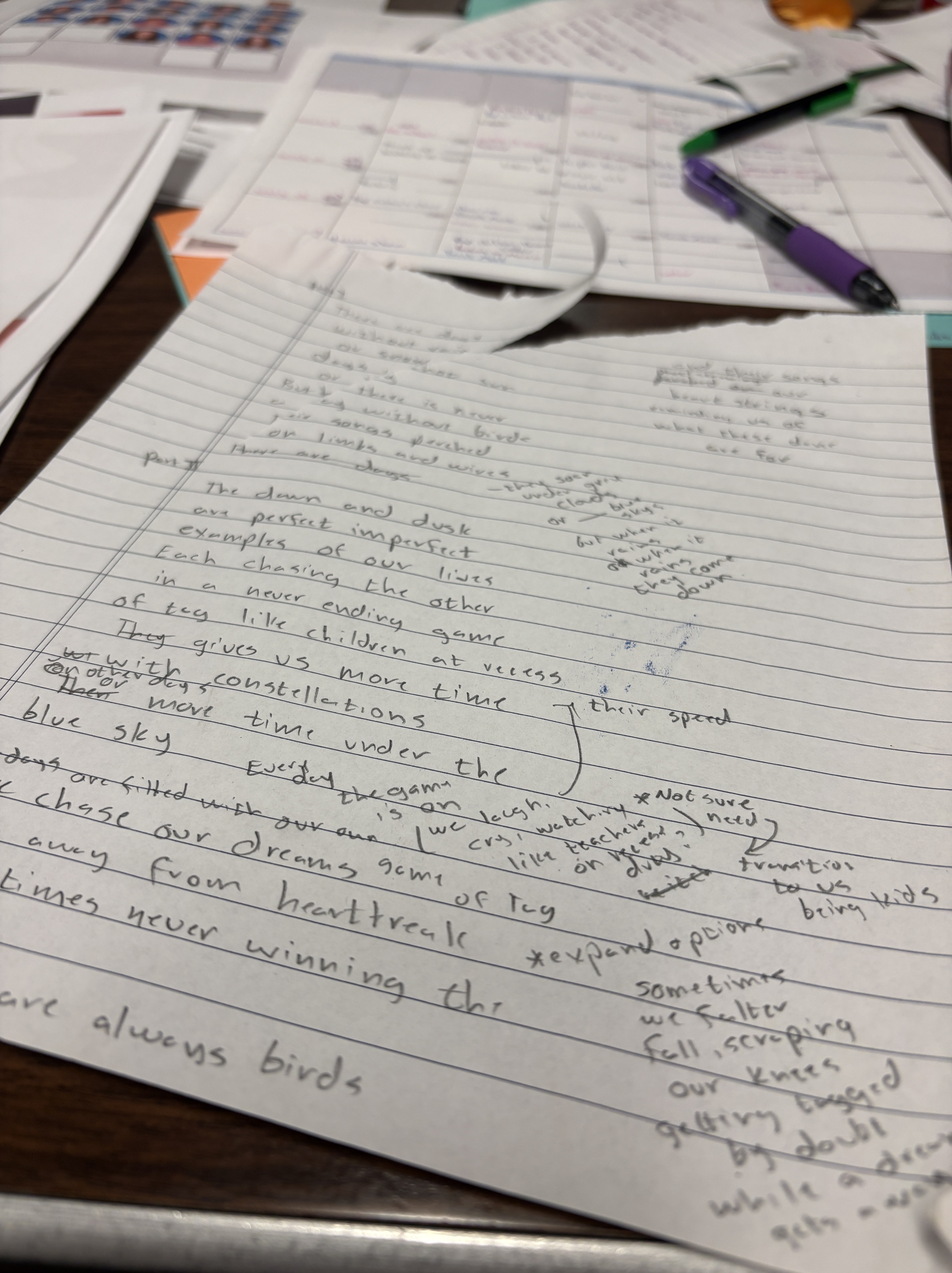
As I walked around the room (I walked over 10,000 steps during the ACT) a poem started to take root. During the break I grabbed a piece of paper and got the ideas down. During instructions and the small break I made notes or added lines.
Because I felt like I had different ideas that still connected, I made the poem into a four part work. I was excited to sit down after track practice to write it and share to the community of poets on the Writer’s Digest site (and other social media).
After dinner I announced I would be writing my poem. The family is used to these kind of announcements, it is just our fun way of letting me have time to write. I grabbed my computer, my headphones, and no poem. I searched my computer bag again. I swore I placed the rough draft in my bag. Nothing.
I almost drove back out to school to get it, but I decided to trust my memory and write the next draft. When I got to school this morning, I checked the final draft to the rough draft, it was almost the same poem. There was a line or two that I changed or added but I would have done that anyway. Second (third, fourth…) drafts always have a change, that is the fun part of writing. Trying to bridge the muse with the audience.
Maybe because the poem took extra work, had extra stress, I like this poem. And with that, here is my dawn / dusk poem:
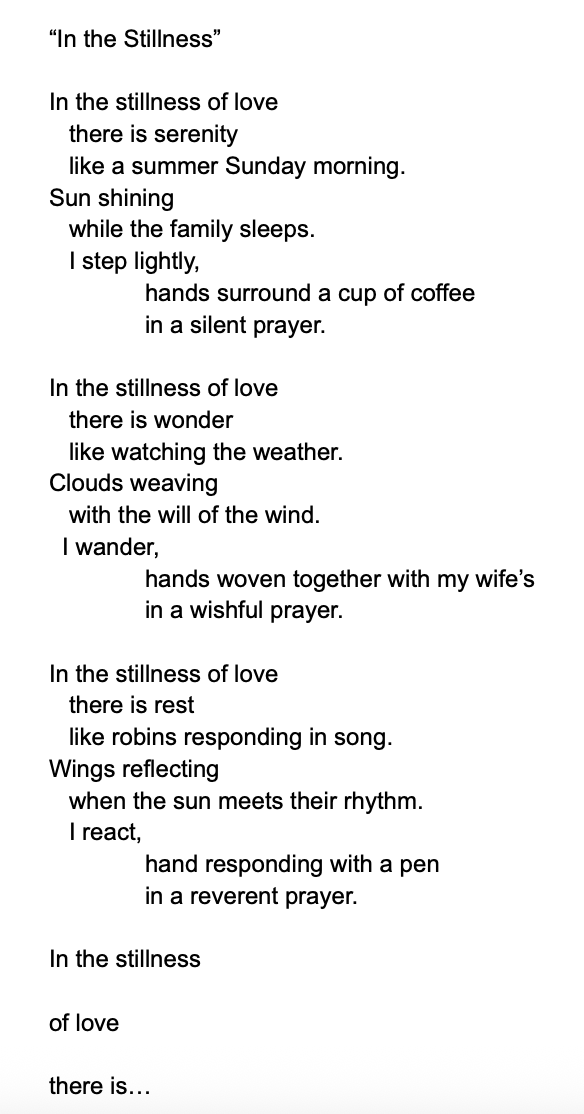
One of the most creative poetic forms is the nonce. Which is a poetic form the poet designs for a specific poem. The poet decides the rules for a poem. On day 20 the prompt was rest. I had a line start in my head, “In the stillness of love.”
And I wrote this poem. I am using the photo option because I couldn’t figure out how to get WordPress to keep the line breaks correct.
The idea of the rules came to me as I started the first draft. The first rule was that I would use a descriptive word followed by a simile. Through the edits, I had to work with both the descriptive word and a creative simile to match it. The third stanza went through a ton of revisions.
As I rewrote my ideas, I noticed that I had unintentionally used alliteration in the first stanza. So, I added that as a rule, and had to rework the second and third stanza again. I didn’t want the alliteration to be overbearing, but wanted it to be clear as the descriptive word was introduced in the second line.
I also went with the imagery of my hands in a type of prayer. Again, this idea came from the first stanza. Which happens sometimes, the base idea is easily transcribed on the page, then the poem is constructed from there. Honestly, the first stanza is almost as is. It is the example of the power of the muse. The other two stanzas took work.
I also like using line breaks and spaces in my more free form poems. It is something I did when I was a younger poet. I like how spaces and tabs can create flow, tells the reader to breathe. As I reworked the poem, the line breaks started to materialize as I scribbled on my yellow legal pad. But the final rules for the look was cemented when I transferred the poem to a Google doc. I could firmly set the rule for spaces and see how it moved on the page.
Because of the challenge of writing and posting a poem in a day, I went with the ending as I wrote it. I am unsure of the ending at the moment. I may revise it later, but the poem is presented here as it was written for that day.
Have you ever designed your own rules for a poem? Share your experience in the comment section.
On day three of the PAD challenge Robert asked us to write a short poem. Nothing longer than 10 lines. Now, there are quite a number of short poetic forms, Robert provided a few in the overview of the prompt for the day. Creating a poem in a few lines, and with the presented rules of a particular form can stretch one’s creative mind.
Throughout the month I wrote some short poems because of how the prompt inspired me. For day three I specifically wanted to use a poetic form. Without any idea for the poem, I decided to write a Shadorma. I like this poetic form (you can expand the poem by making stanzas from the guidelines).
But I had no theme or prompt word to go with it. So, I had a different hurdle to overcome. Here is the poem I wrote that day. I will discuss how I got the idea afterwards.
My heart is
a candle whose flame –
surrounded
by darkness –
jumps and sparks trying to keep
the light from fading.
Writing in poetic forms has a built-in challenge. Meshing my ideas within the rules of a form can take days, even weeks for me to accomplish. Throw in a short poetic form, and write it in a day for the PAD challenge and I sat there drinking my coffee with my head spinning.
With or without a poetic form, short poetry is not easy. The theme and intensity of an idea has to come through in just a few words or lines. And it has to hit the reader, hard. At least I think it does. Short poetry should be like drinking a shot, full flavor that then sits warm in the reader’s mind.
The idea for this poem started with the candle that sat on our island. We tend to keep a candle on the island that we light at the end of the day. Just a part of our family routine. I noticed the burnt wick, dark and frayed. Then, I started to consider how bad the year had been. I then considered the sayings about a single light against the darkness. In my mind I saw a candle in the middle of darkness, how small the light was. I thought about how fast the darkness would be complete if the fire on the wick sputtered and went out.
I had my idea.
I used my lunch period to work through the poem. I started with the metaphor, “My heart is a candle…” I actually had to work line 3 and 4 through a few different versions. These lines are only three syllables long. I wanted the tension of the darkness surrounding the flame to come through, to have that tone of sadness to hit and stay throughout the poem.
Here is where punctuation makes a difference in the poem. I could have used commas. But the emdash created the tone I wanted for the weight of the darkness. I then continued with the imagery of the flame that was fighting to stay alive.
Writing this poem encompassed the importance of punctuation, the challenge of short poetry, and how everyday objects, the candle on the island, can be the spark for inspiration. I think the poem also reinforces the power of writing in a poetic form, it can make you really delve into word choice, theme, and expression that you might not normally do.
Let me know what you think of the poem, or of any of the ideas I discuss in this post. Share your thoughts in the comment section.
Robert Lee Brewer has some favorite prompts he uses for the PAD challenge. One of them is the BLANK prompt. Robert gives a word and the filler BLANK with it. As poets we are supposed to use it as the title of the poem. This poem was written for the prompt, New (Blank).
“New Hands”
I wish I had new hands.
These do not write great poetry
or handle precious things properly.
–
My hands are callous and scarred
from traveling too far
from other hands
that only wanted
to know
I would never let them go.
–
These hands have broken
bread with no intention
of keeping
the promises set
at a table
I was invited to
but no longer
have a seat at.
–
I wish I had new hands.
These ache
with the weight
of carrying
the expectation
of caring
for a family tree
I’ve never enjoyed
the shade of.
I planted my own sapling
in soil I created
by breaking the stones
that held generational sins.
–
I wish I had new hands.
These are pale
from years spent in darkness,
fighting against the scales
Fate used in measuring
my worth.
No matter what I paid,
what dreams I placed
on the plate,
it never balanced
my life’s fulcrum
because Fate
kept its thumb
on the plot
I thought I was writing.
–
I wish I had new hands.
These are failing
in doing the work
of living a life
worth holding on to.
Poetic Form: Spoken Word
I sat with the idea for this poem for a while because of doubt. I am not sure what triggered the idea of having new hands, might have been just noticing my hand as I drank my coffee, but I was unsure of the idea. The idea of replacing my hands simply seemed unrealistic.
The line, “I wish I had new hands” just kept running through my head. I considered some poetic forms that use a refrain for the idea. Poetic forms like the quatern, the dansa, and the kyrielle. But as I wrote down a few lines, the forms didn’t feel right.
I actually tried to come up with some new ideas for the prompt, like “A New Day”, “New Words”, and some other ideas written on a post-it note. But I couldn’t shake the idea of new hands. I couldn’t shake the doubt either.
In fact you can read the doubt in the first stanza.
I’ve learned over the years to trust the muse more than doubt. It is hard, but once I take the first steps into the idea my creativity takes the wheel. Besides a few edits, this poem is as it was written on the yellow legal pad I used for writing during the PAD challenge. I wanted to write in longhand for each first draft during the challenge.
I also stayed with the more negative idea of why I needed new hands. But kept the idea of a refrain to start each section that dealt with the reason for why my hands were falling. I also focused on how the poem sounded as if I was at a poetry slam. That is why there is inconsistent rhyming, alliterations, and different line breaks. I do hope to use this poem in a poetry slam this summer.
The writing of “New Hands” highlights the battle I face sometimes between doubt and the idea the muse gives to me.
Please feel free to share how you deal with doubt in the comment section.
I thought it would be fun to share my creative process for 5 (of the 30) poems I wrote last month for the Poem A Day challenge. I did something like this in February and I have always enjoyed the stories of inspiration from artists. I have a number of iTunes Originals albums that combine an interview with music from the artist. So in that vibe, here is the first of five blog posts about writing poetry. Side note: I use the prompts provided by Robert Lee Brewer of Writer’s Digest.
Day 11 Prompt: Nature
“Clouds”
Even
when they look like a child cut them out of white fabric,
clouds are in constant motion.
Edges shifting,
water vapor colliding with dust.
Internal turmoil
that we can not see,
only feel when we get caught in the rain.
Poetic Form: Descort
First, the descort poetic form is one of my favorite forms to write in. The rules are simple, no line can be the same in the poem. That means no rhyming, different syllable count, no repeat of literary elements. Each line is unique. I love the challenge this form gives.
During the month of April, I tried to learn the prompt for the day as soon as I could, usually as I took the first sips of my coffee. That way I could think about it and try to write a rough draft during my lunch break. But on this day the idea came to me on the drive to school. Ironically, this is the second poem that was inspired during the same time (The Creative Process).
The horizon is clear for the last part of our drive to school, and the sunrises can be beautiful. On this day the clouds caught my attention, they were moving, shifting. And here is where ideas can be generated because you are thinking about something specific. The muse can be called. You do not have to wait for inspiration.
Knowing I had to write a nature poem, my thoughts started to center on the clouds, and why they changed. Even though I wasn’t looking at rain clouds, I thought about what triggers the cloud to release the rain.
When I got to school I researched how clouds generate rain and what conditions allow for the rain to fall. I had already decided that the theme of the poem would be centered on us (people) not knowing what a cloud was going through. A metaphor for people not knowing what other people were going through. Also, I had already decided that I was going to use the descort form because of its shifting style. In this case I felt the form perfectly matched the theme of the poem.
After researching how rain worked inside a cloud, I jotted down my main ideas. Very rough first draft.
Now, there is a mix of magic and artistic goals in any work of art. I wanted the poem to start out on a positive note, then move to the rain, and finish with the reveal of the theme. I knew I wasn’t worried about rhyming, but I did have to pay attention to my line breaks because each line had to have a different syllable count.
I think I revealed the tension of internal conflict well in the opening three lines (in fact a single sentence). Then I used the information I learned about rain and finished with my theme. That we don’t know the internal struggle of clouds (people) until we have been caught in the rain.
This poem’s creation came rather quickly, but highlights the importance of researching so that descriptions can be accurate, and that creativity can be generated with a focused mindset.
Let me know what you think of the poem, or if you just want to share your creative process with me in the comment sections.
Every week there is a poetic battle challenge (X account is @The_PoetryArena) I compete in on a regular basis. Prompt word is revealed on Wednesday. Then poets submit their poems on Friday / Saturday. Five poems are selected as finalists on Monday. The community votes on Tuesday and then Wednesday the winner, crowned as the Voice Of Valo(U)r, provides the next prompt word.
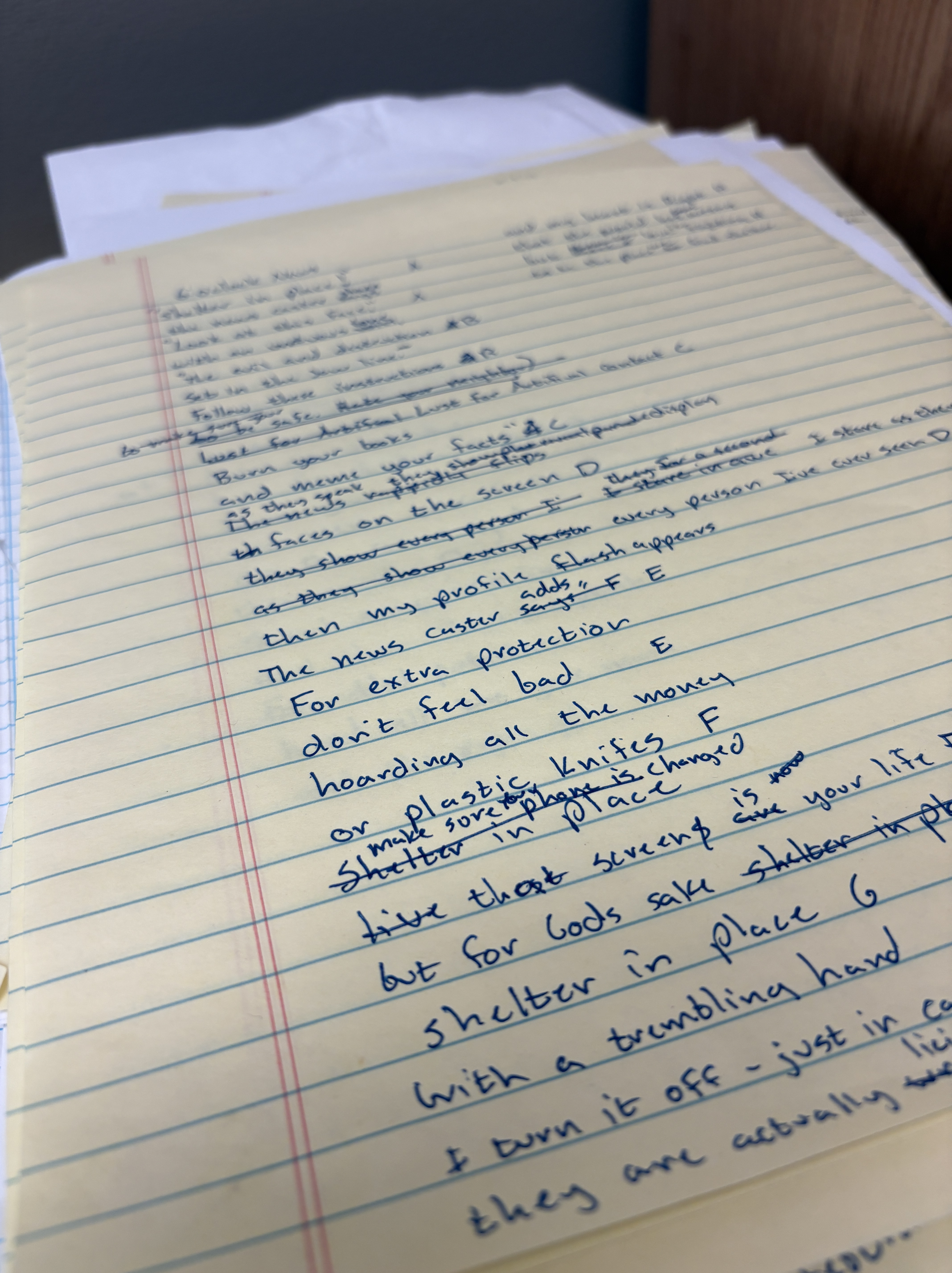
This morning the muse hit me again as I was driving to school. I had this idea of “sheltering in place”. And I honestly don’t know where the idea came from, but as I was driving the idea blossomed into an idea of a newscast stating the command.
Again, when I got to school I started jotting down the idea. The first draft was kind of short and actually more like just the idea. I had some lines down but more notes of imagery and theme.
Then came the second draft.
The poem wanted form. This honestly is the magic of writing. I didn’t actually research more traditional poetic forms, I ran with the idea of using a rhyme scheme of AxAxBxBx and so on. I did think about syllable count per line, but decided to run with a more natural break in the lines.
As you can see I had to actually identify the rhyming lines because as I edited for flow and word choice, I got lost on which line needed the rhyme.
Another magical aspect about this poem is that I had no idea how it would end. As I wrote the poem, the theme emerged through the rhymes and play on words. And I also felt the weight of what is going on in our country mix with the tension of what I believe life should be about, come through in the lines as I wrote. I wasn’t planning on a happy ending… but it is an honest ending.
I did some heavy editing on the second draft, then transferred the poem to my computer so I could submit the poem to this week’s battle. And so, it will be interesting to see the poetic journey this poem takes.
The overall process was the same for each poem, but this time there was more work involved in the final draft. Even though I wasn’t using a traditional poetic form (which sometimes calls for a lot of editing) this poem’s creation was more intense. I had to mesh the rhyming rules with my idea. That work was a joy though.
Feel free to comment about your creative process in the comment section or on social media.
Yesterday, the muse hit me as we were on our way to school. I was driving, so I kept repeating some lines of a poem in my head so I could jot them down when I got to my classroom. As it happens, more lines came to me as we got to school.
As soon as I sat down, I released the poem onto a yellow legal notepad. I thought it would be fun to share my creative process on X as I spent time working with the poem.
Here are those posts:
Post One:
Love the creative process… first is jotting down the lines I had in my head as I was inspired on the drive to school…
Post Two:
The second step (for me with poetry) is to consider if the main idea of the poem can be better expressed through a poetic form. So what I will do is consider the rules of longer poetic forms (the poem is a page long at the moment. If a form stands out I will rough draft (cont)
the poem in that form. Then I have to make a hard creative decision. I decide if the poem works in the poetic form, or as written. I will still work on word choice, flow, things like that after that decision… I’ll let you know what I decided when I get the chance…
Post Three:
So step two has been completed. I will not be using a traditional poetic form, I will work with the poem as it was written on the page (step three). Forms I did look at: cywydd deuair hirion, kyrielle, rimas dissolutas, and Ya-du to name a few….
Post Four:
Step three of the process is the work on the poem. I have edited the original draft, but now have rewritten the whole poem on a new sheet of paper working the edits in. The 2nd draft also focuses on line breaks, tempo, things like that… I will rewrite the whole poem (cont)…
a number of times. I do that so I experience the whole poem, not just the edits. When I feel I have the poem ‘right’ I will transfer it to my computer.
Post Five:
Side note for creativity… To a degree I trust my gut regarding decisions about the poem. No poetic form felt like it would enhance the theme of the poem, trust the feel of the words on the page as I write. So, there is always the risk of getting something ‘wrong’ (cont)
in the sense that the poem isn’t the best it can be. Or the bridge to the reader is not strong. But the more one works on their craft, they can trust their gut more, and be OK when it doesn’t seem to hit correctly…
Post Six:
Step 4 is easy. Transfer of the work onto my computer. But step five is a challenge… what to do with the poem. I was going to share it in the next post, but as soon as I do that I can not submit the poem for publication consideration… And I like how this poem (cont)
turned out. I like the imagery and the theme. I want to share it, but am now thinking about seeing if someone else would like it enough to publish it. So, at the moment I am going to submit it to some journals. Hope you enjoyed this look into the process of writing a poem today!
And so I have a new poem in my folder “unpublished 2025” and I am looking for opportunities to submit the poem.
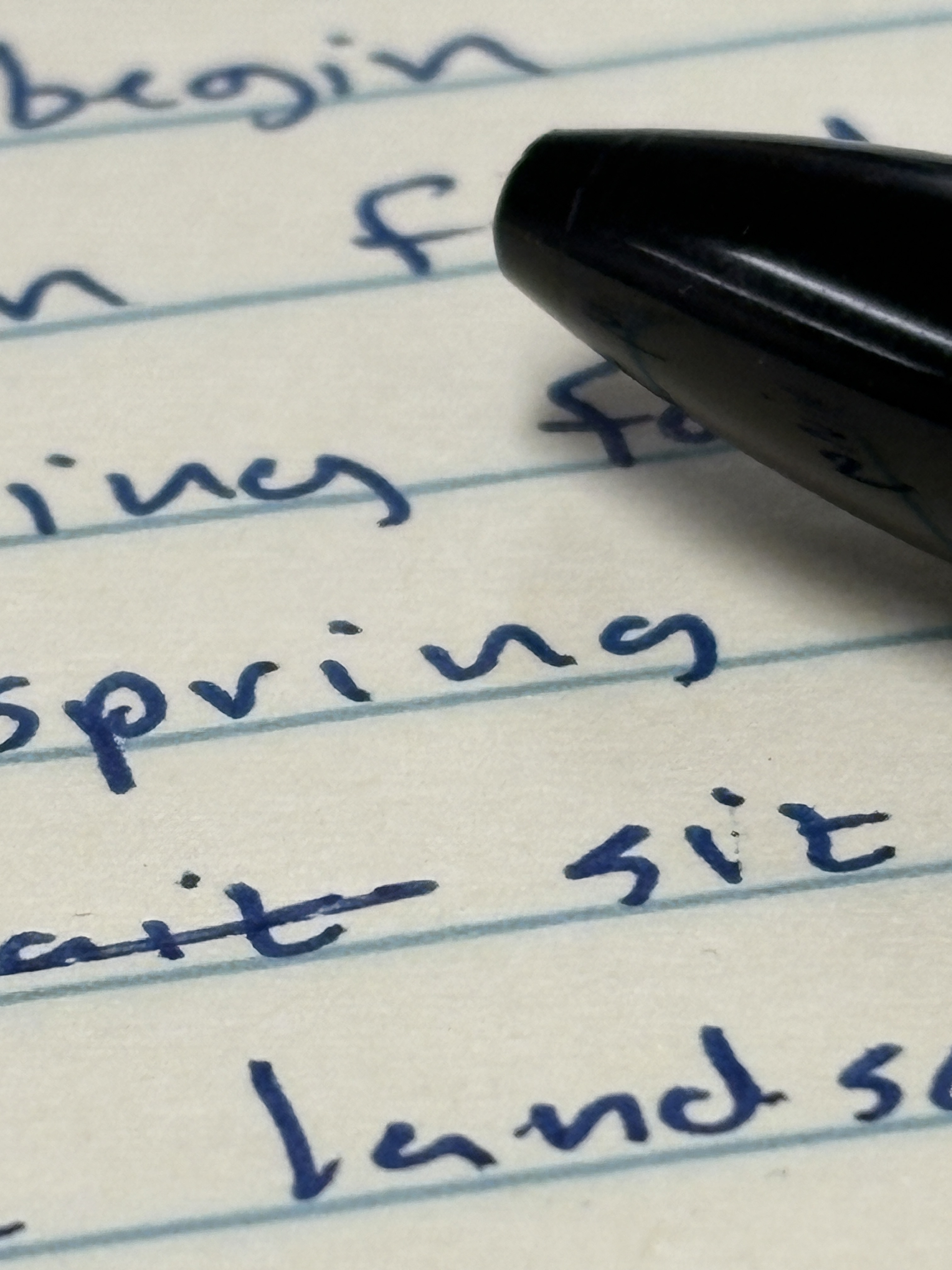
When I write blog posts (like this one) and short stories, even my novel ideas. Step one is kind of the same. I do like to get ideas down on paper, even if I use my phone to record an idea, like I do when I walk. I personally like the sense of creation as I write. The feeling of the pen, the way the ink evolves into words.
In some ways, I can’t forget about that idea because it is in the real world. So, would love to hear about your creative process. Share in the comments, or reach out to me on social media.




 It is all Connected