Tag Archives: April

My Poetic Philosophy

I love April. Even though life is busy with teaching, coaching, and just general dadlife, the challenge of writing a poem every day brings a welcomed level of stress. My students know I am a poet, and have asked to hear some of the poetry. I have also had the opportunity to just talk about poetry and creativity with them.

Today, I wrote a poem that was inspired by my walk. I had already composed and shared my poem for the prompt today (which was ‘home’ – you can read it on my X feed). As I reworked a section of the poem, I felt like the poem represented my basic philosophy of poetry. Now, I have written all kinds of poetry, have written in over 100 different forms, but since I have shared my creative process a number of times in the last year, I thought it would be fun to share this poem and explain how it fits my general philosophy of poetry.

Some background first. Some info from the poets I admire.

Robert Frost, states in the preface “The Figure a Poem Makes” that a poem should start in delight but end in wisdom. Later he expands on the point, highlighting how the wisdom is not always grand but the simple depth of living, that a poem “ends in a clarification of life.” If you are a faithful reader of my poems (and even my blog posts) you can see this revelation at the end of many of my works.

Langston Hughes is my favorite poet, and most people don’t know that early in his career he was criticized for what makes his work loved now, the reality of life. Lifting up the working class and street people of Harlem. And bringing them into the discussion of the social issues of our nation. But he also threaded a spiritual aspect into his work. Langston once said that poetry was “the human soul, squeezed like a lemon…” I do not write a lot about social issues, but I do try to squeeze my soul until it forms a poem on the page.

I am also a fan of the Romantic Poets, Wordsworth, Keats, Shelly and the likes. Nature and the common life were driving forces for their poetry, and mine. Which brings me to today. After my walk I sat down on my front step and jotted down the first draft of the following poem (which is presented in its final version).

“April 11, 2026”

The battle between seasons

is taking place on lawns,

yellow brown grass fights for ground

against lush green blades 

that are backed up

by bright yellow dandelions.

The air smells of a rain waiting,

a tint of mildew,

heavy and sweet.

While the wind blows 

its war horn

from the north,

cold and biting. 

Warning that freezing storms

are still possible.

The sky a grey blanket

with no seems to be seen.

And I am walking through

the middle of it all.

My heart holds on to winter,

while my mind yearns

for the thaw of spring.

A war between seasons

for the right to call

this day theirs.

This poem, I think, represents my voice well. The first stanza is a picture of the day during my walk. Revealing the tension of the weather during the days between the seasons. There is beauty in nature, a power that touches our souls, no matter what the weather is.

Then in the second stanza I squeezed my soul. Revealed a spiritual tension that I hope connects with the reader. A wisdom that they can read and then say, “I understand that feeling, too.” And with that inspiration to highlight the richness of our everydayness, I used the date.

The one aspect of the poem that is missing from my style is the use of a poetic form. Which I played with the idea, but the poem felt truer as a free verse based poem. And I am learning to trust my poetic instincts.

I hope you enjoyed the new poem and getting to know me a little more as a poet as I shared my poetic philosophy. Here is to a great rest of April and all the poems I will write.
Leave a comment

Filed under Life, writing

The Backstory to an April Poem

April is National Poetry Month, and many poets write a poem everyday. I am one of those poets. I use the prompt provided on the Writer’s Digest site. I read the prompt in the morning. Let it sit for a while and then find time to write the poem. During that time I also consider different poetic forms to use. I have written three poems so far in forms I’ve never used before. I like using this month to work on my skill set and to experiment a little.

I wrote a poem yesterday (April 7) that I really like. And writing the poem has backstory that highlights the creative process.

The prompt for April 7 was a Two for Tuesday situation: Dawn or/and Dusk. Robert Lee Brewer is the editor for the poetry section for Writer’s Digest. He is the one that provides the prompts, and Tuesdays have always been a double sided prompt.

My first reaction was actually lackluster. Nothing really jumped out at me while I had my morning coffee. I also knew that I would be helping monitor a room for the ACT yesterday. Our school administers the ACT for our juniors every year. My only job is to walk around and make sure ovals are filled in correctly, handle any questions. I don’t even say anything regarding instructions. 

As the testing got started I was not thinking about the prompt, instead I had this idea in my mind from a book I recently read, Birds Art Life: A Year of Observation by Kyo Maclear. She ends a chapter with a line about how there is never a day without birds.

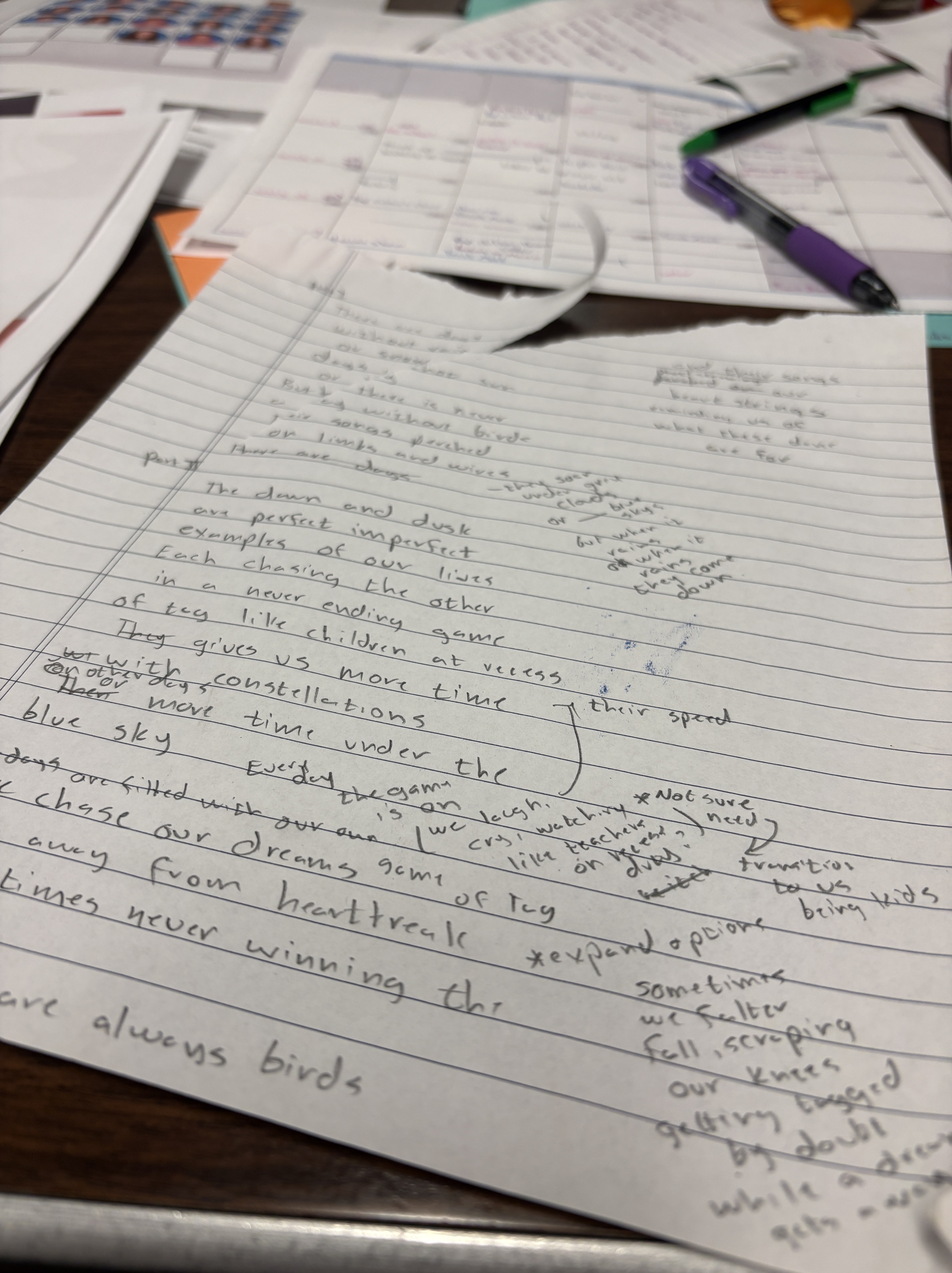
As I walked around the room (I walked over 10,000 steps during the ACT) a poem started to take root. During the break I grabbed a piece of paper and got the ideas down. During instructions and the small break I made notes or added lines.

Because I felt like I had different ideas that still connected, I made the poem into a four part work. I was excited to sit down after track practice to write it and share to the community of poets on the Writer’s Digest site (and other social media).

After dinner I announced I would be writing my poem. The family is used to these kind of announcements, it is just our fun way of letting me have time to write. I grabbed my computer, my headphones, and no poem. I searched my computer bag again. I swore I placed the rough draft in my bag. Nothing.

I almost drove back out to school to get it, but I decided to trust my memory and write the next draft. When I got to school this morning, I checked the final draft to the rough draft, it was almost the same poem. There was a line or two that I changed or added but I would have done that anyway. Second (third, fourth…) drafts always have a change, that is the fun part of writing. Trying to bridge the muse with the audience.

Maybe because the poem took extra work, had extra stress, I like this poem. And with that, here is my dawn / dusk poem:

“Days”

Part I

There are days without snow,

and rain.

Days without sun, friends, and

even clouds.

But there is never a day without birds,

their songs perched on limbs and wires.

Part II

Dawn and dusk

are perfectly imperfect examples

of the way our lives revolve.

Like children

running on grass and blacktops

in a never ending game of tag.

Dusk’s speed of foot gives us

more time to star gaze,

other days Dawn’s endurance

allows us to play

under the sun longer.

Neither of them seem

to care to win the game.

Part III

We are children, too.

Playing tag with our days.

Running toward hopes

and aspirations.

Running from heartache

or doubt.

But we stumble,

scrape our knees on the concrete,

get tagged by despair,

cringing as it yells,

“You’re it!”

With lungs burning

we find ourselves running, again.

Tears warping our vision.

Part IV

But there is always the birds

with their songs

strumming our heartstrings 

reminding us what these days

are really for.

Leave a comment

Filed under Life, writing

PAD 2025: Poem 1

I thought it would be fun to share my creative process for 5 (of the 30) poems I wrote last month for the Poem A Day challenge. I did something like this in February and I have always enjoyed the stories of inspiration from artists. I have a number of iTunes Originals albums that combine an interview with music from the artist. So in that vibe, here is the first of five blog posts about writing poetry. Side note: I use the prompts provided by Robert Lee Brewer of Writer’s Digest.

Day 11 Prompt: Nature

“Clouds”

Even 

when they look like a child cut them out of white fabric, 

clouds are in constant motion. 

Edges shifting, 

water vapor colliding with dust. 

Internal turmoil

that we can not see, 

only feel when we get caught in the rain. 

Poetic Form: Descort

First, the descort poetic form is one of my favorite forms to write in. The rules are simple, no line can be the same in the poem. That means no rhyming, different syllable count, no repeat of literary elements. Each line is unique. I love the challenge this form gives.

During the month of April, I tried to learn the prompt for the day as soon as I could, usually as I took the first sips of my coffee. That way I could think about it and try to write a rough draft during my lunch break. But on this day the idea came to me on the drive to school. Ironically, this is the second poem that was inspired during the same time (The Creative Process). 

The horizon is clear for the last part of our drive to school, and the sunrises can be beautiful. On this day the clouds caught my attention, they were moving, shifting. And here is where ideas can be generated because you are thinking about something specific. The muse can be called. You do not have to wait for inspiration.

Knowing I had to write a nature poem, my thoughts started to center on the clouds, and why they changed. Even though I wasn’t looking at rain clouds, I thought about what triggers the cloud to release the rain. 

When I got to school I researched how clouds generate rain and what conditions allow for the rain to fall. I had already decided that the theme of the poem would be centered on us (people) not knowing what a cloud was going through. A metaphor for people not knowing what other people were going through. Also, I had already decided that I was going to use the descort form because of its shifting style. In this case I felt the form perfectly matched the theme of the poem.

After researching how rain worked inside a cloud, I jotted down my main ideas. Very rough first draft.

Now, there is a mix of magic and artistic goals in any work of art. I wanted the poem to start out on a positive note, then move to the rain, and finish with the reveal of the theme. I knew I wasn’t worried about rhyming, but I did have to pay attention to my line breaks because each line had to have a different syllable count.

I think I revealed the tension of internal conflict well in the opening three lines (in fact a single sentence). Then I used the information I learned about rain and finished with my theme. That we don’t know the internal struggle of clouds (people) until we have been caught in the rain.

This poem’s creation came rather quickly, but highlights the importance of researching so that descriptions can be accurate, and that creativity can be generated with a focused mindset.

Let me know what you think of the poem, or if you just want to share your creative process with me in the comment sections.

1 Comment

Filed under Life, writing