There has been a line from Tim McGraw’s song “Humble and Kind” that brings me to tears every time I hear it.
How many moments have I lost over the years?
“Hold on, I’m tired. Give me a second,” I would say as my daughter just wants a hug. So, she just heads to her room to play alone.
Or I would just holler to my wife that I was home, then sit in the chair and turn on the TV. I might ask what’s for dinner as she walks into the room.
Or the thousands of letters or cards I never sent to friends and family.
Or how many summer nights I could have sat outside watching the stars with my sons.
Love is not only given but it is received. And sometimes that is the hardest part of the equation because we let so many insignificant things fill our time. We miss the purest expressions of love from others because our attention is on other things. I take for granted that my family will be happy to see me when I get home. I take for granted that the stars will shine tomorrow night. I’ll write that letter, later.
If we would take the time to recognize the love we receive from others, I believe we would be amazed on how deep this life can be. In any given moment this life is showing us that we are loved. We give love, but we must also receive it. Today is too wonderful to take it for granted.
It has been an interesting year for a number of reasons. But this post is about what I’ve learned from my students over the past year. Some background information, last year was my first year teaching a regular lecture college course for Central Community College (CCC). This semester I am teaching an online course for CCC. In the past I have taught the early entry courses for seniors taking dual credit courses through CCC. Even though I taught a college course, my everyday teacher life was centered in the high school routine. There is a difference between high school students and college students at CCC. This is what I’ve learned.
Education Matters
Even though I lost students over the year to a wide range of issues (I’ll talk about that in a few lines), students understood that gaining an education was important for them to reach their professional goals. I had one student who used her lunch break to attend my class. She would arrive a few minutes late, in her nursing outfit from work, and was raising a family. Another student had worked construction for almost two decades and loved it. But an accident kept him from returning to that job. He was studying business in hopes that he could return to the company in a new position.
My students understood that getting an education was going to help them reach their goals. But it is not easy.
Life Can Be a Hurdle
In high school, life is school. Football games, dances, school, they are all part of the everyday experience. For many of my students at CCC class was just a section of their life. I had students in class that ranged from 18 to 63 years old. I have a student right now who is traveling the world and taking my course online to get some general education credits handled before he comes back to the States. I had a young man at the age of 21 who had already gone through rehab twice.
I am proud to be a part, however small, of their lives. But life did cause some hurdles that challenged my approach to teaching. One aspect was the workload I expected from them. It made me think about what was really important for them in my course. This was hard for me because I love sharing extra material, to try to foster learning beyond the curriculum. I had to consider what I asked of them regarding assignments and homework. Not that I took it easier on them, but it forced me to align my course work according to importance and expected time spent on it. A simple example is that I used class time to handle small assignments and tried to give feedback on those right away because many of the assignments connect to their essays (which are the major assignments for the course). This allowed my students to work on the essay at home with more confidence in their ability to accomplish the writing.
Education versus Learning
This area is still challenging me, and maybe it always will. But not in the way you might think. I know many of my students only take my course because it is a general education course that all programs require. I actually lean on that idea to emphasize the importance of taking the course. I repeat, over and over, and over, that the number one goal is to help them become better writers for this course, for upcoming courses, and even for life. I present them with a WHY. Many of my students just want the credit, I know this. But their learning is their education which is their life, their goals. My battle is in creating a course, an assignment, or developing content that aligns to that WHY. And yes, I believe it matters.
The student who used her lunch hour to attend my class has two children and she revealed why it matters. During one session on writing with tone/voice, I was discussing how this characteristic of writing was the reason we like certain books, songs, and other media. I continued to expand on how important word choice was in creating that tone or finding their own voice. Unbeknownst to me at the time I connected the WHY to her life when I lead a discussion on how hard it can be to write a personal letter to someone expressing our feelings (word choice/tone). I shared a personal example of writing a card for my son, and even how hard it was for me to get that card right. I happened to then share that that type of writing was just as important as an essay for my class, which I believe. At the end of that semester, which ended in December, that student sent me an email to tell me that she was excited to write a Christmas letter to her children and husband sharing how much she loved them. She wanted to make these letters a new tradition for her family.
What my students taught me was that education matters, for their goals, for their life.
I am amazed by your talents. Each of you have unique gifts that make being a parent awesome. You are lucky to have discovered your talents at such a young age. Each day I see how your talent continues to improve. It is an honor to be a part of that process. As you stand on on stage, make a no-look pass, or draw a new animal, I see a glimpse of your heart. This letter is meant to help you grow and work with your talents in the future. Yes, it is parental advice, but that is a benefit of being your dad.
First, it is your talent. You are responsible for developing it. You are responsible for how you use your talent. You decide if you continue to work hard at being an actor, a basketball player, and an artist. No one else has that responsibility (we will talk about other people in a minute). And that responsibility means you can let your talent slide. My fatherly advice is don’t. I know the regret of letting a talent go… of not focusing on the development of a gift. You know that I quit football after my freshman year in college. I still wonder what I could have done on the football field. You know that I write now, but in a way I let writing slide for too long. As a senior in high school I received a Young Author’s award. I let too many years go… I will never get them back. I never got to put on a uniform again… It seems like life is forever at your age, but it is not. Opportunities to use your talent are limited. Don’t waste them. I believe there is a reason for everyone’s talent. Yes, I am about to go deep.
Our talents gives us depth to our lives. It is not the only thing that makes life meaningful. There is love, family, friendship, but our talents add to that mix. Your talent will enrich your everyday experience. Your talent gives you direction in this life, if you have the courage to use your talent as a life compass. When faced with hard choices, ask yourself which options best benefit your talent. Yes, I am talking about things like alcohol or drugs or any other peer pressure situations. But also about situations life hands you, like friends, job opportunities, situations you have not encountered yet. Of course there are other factors in major decisions, but your talent is an important factor. If you make choices that help you develop your talent, you will find the right direction. I didn’t say easy… just that you will not regret a choice that is centered on strengthening your talent.
Here’s why: other people. Let’s deal with the positive aspect first. I also believe that there is another aspect to the responsibility of our talents. By developing our talents we can help other people see what they are capable of in this life. In a simple, everyday way, our talents make this a better world. You are a role model through displaying your talent. I was reminded of this through a few situations where my writing had an impact for people that I did not know were influenced by something I have written. Your talent shows others what can be. It shows others the beauty of this life, the richness of living. And you never know who that might be.
But here’s the flip side of other people, the haters. I wish I had an answer to this issue, but I don’t. And I know how powerful negative people can have on developing or showing your talent. Their comments and attitudes can make you feel like hiding your talents. Can you image what our world would be like if we lifted people up instead of trying to destroy someone simply because they are good at something? It would be amazing. I can’t stop the haters. But be strong, be courageous, at the end of the day you know mom and I will be here for you. Draw all the lions you want. Sing your heart out. Take the 3 or drive to the basket. Embrace your talents. Work hard. Prepare for the hard spots in life, they will come. But most of all enjoy where your talent takes you, it’s going to be a beautiful life.
Love, Dad.
I cried today because of an email delivery failure.
I sent a group message about a guest blog post I wrote. I received the basic message for when an email account is no longer active.
The account was for my good friend Graci. I attended her funeral last Wednesday. She passed away from cancer. She would like the blog post I wrote.
This post is not going to repeat the cliche that we should live like everyday could be our last. This isn’t about making sure we tell the people we care the most about that we love them. These things are true. We know it. What we forget is how permanent Death is.
I will never again text Graci to have a good day. There will no longer be crazy life conversations in her office. She will not read this blog post. Death is permanent. That is why it is so hard to deal with. Graci’s funeral was filled with family and friends. She lived out her faith. She made people feel loved everyday. The service helped us celebrate her life, but death is permanent. Death removes all possibilities. That is what hurts. The lost chance to live like today was our last day.
“My shoes?” my youngest daughter asks. Right now almost everything is a question.
“My daddy?” she asks after daycare.
“Yep, I’m your daddy,” I would say. Then she would smile. I totally understand Tim McGraw’s song “Grown Men Don’t Cry” now.
But back to the shoes. They are light-up Paw Patrol shoes. My little girl ran around the living room making the shoes light up. Every few seconds she would ask if I had seen the lights on her shoes. Then she would ask mom, the girls, my oldest son. “See my shoes?”
I will be honest, I was hit with the fact that I would soon not buy another pair of light-up shoes. I’m pretty sure that every one of my kids have gotten a pair of light-up shoes. They would run around making them light up. They would smile. It was the best day of their young lives the day they got light-up shoes. Such a simple thing, but brings such a pure joy.
My oldest son was eating a quick breakfast, he had speech practice this morning. But he stopped and responded to his sister. I wondered if I had done anything for him so he felt like he was having the best day of his young life. I was a washed with dad guilt. Raising six kids, being a husband, being in the middle of figuring out a career, can make life feel restricted and stressful. But it is the small things that make the biggest difference in this world.
Love is expressed in the small things, an unexpected hug, a funny GIF sent in an email/text. A handwritten note can clear away the storm clouds. A favorite drink or candy bar can change a person’s view. Or having pockets…
My daughter stops in front of me. Her hands are stuffed into her little front pockets of her pants. “I have pockets!” It is not a question. Then she takes off running with her hands still stuffed into her pockets. My dad instincts kick in, I hope she doesn’t fall as she makes it to the front door.
“My coat?” she asks with a smile.
It’s going to be a great day, even if I do shed a tear.
Good morning. Or afternoon. Or evening. I don’t know when you might come across this post, but I wrote it for you.
Let’s cut to the chase, we need you to be great today. No, seriously. We need you to be on your game today. We need you to be a great mother or father, a great friend, a great person, a great writer, a great YOU. Here’s why.
The world has enough average people. The world has too many below average people. The world has enough hate, disrespect, and coldness. What we need is you to be great. To be strong. To live your life to the fullest at this moment.
I can hear some of you, life is too hard to be great. Thank you for proving my point. How is being less than your best helping make your life better? It is not. I know that it can be crazy getting the kids ready for the day. But being average, being rattled, being short and snippy at the kids does not make the moment better. Being at your best is not a guarantee that getting the kids ready in the morning will not be work, but it sure makes the moment better.
Life can be hard. I know that. Which is even more of a reason for you to be great, to live your life to your greatest potential. Your life needs you to rise up to a higher level.
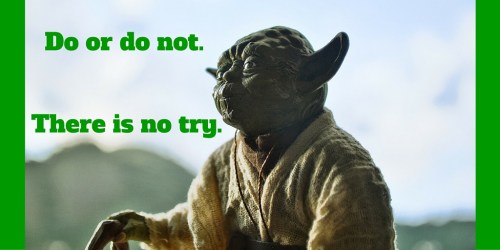
I can hear you, too. I’ve tried being better but it didn’t work. Yoda was right when he said:
The word TRY gives us an excuse not to succeed. To not be our best. It deflects the responsibility of our lives to an abstract idea or worse to another person. You either live to your potential or you don’t. Stop trying. We need you to BE GREAT. Your family, your dreams, your life needs your greatness. I know you you know it. Now live it.
Share this with anyone you know who might need a reminder that we need their greatness.
It is Sunday morning. I am making blueberry muffins for the family. Big mixing bowl, muffin mix, two eggs, ¾ cup of milk (not water), and ¼ cup of oil. Blueberries are drained and waiting. It is a familiar routine. It is a foundation of our family. A simple thing that helps keep the family and me from getting lost in the turmoil of life.
This morning I am still reeling from the feelings of doubt and uncertainty. I had a number of opportunities that I felt qualified for, but wasn’t even given a chance to prove myself. No interviews, sessions not accepted for conferences. I know that there are so many factors involved in the process of selecting candidates for a position, but, honestly, rejection hurts. You wonder why. You wonder what didn’t they see in you.
These questions fill my head as I get all the ingredients mixed and fill the muffin cups. The oven beeps that it is heated to 410 degrees. I place the pan in the oven and set the timer for 18 minutes. I grab my coffee cup (I make my coffee before the muffins) and sit at the table thinking.
Success is a tricky concept. It can be measured by money, titles, or objects if that is your definition. But what if you just want to do your best, to help people be better, to raise a strong family? What if your idea of success is happiness? How is that measured?
Part of the way we measure that type of success is from our jobs, from the impact we make in our field of expertise. Those are hard to measure and sometimes the most challenging aspect of success because of change. A new boss, chasing a goal, or a decision made by administration. Things change and sometimes we don’t know why. Life doesn’t always go our way and we don’t know why. That is why doubt can bring you down, you can’t argue against it when there is no easy measurement to counter its voice.
The timer goes off. The muffins have a golden hue mixed with dots of blue. They smell warm and tasty. The family gathers around the table. Glasses are filled with orange juice and milk. Butter is applied to the muffins for those who want it. There is chatter, request for more drink, and even laughter.
Sometimes success is measured not by money or a job, but by a dozen blueberry muffins every Sunday morning.
Last week I read, “School Libraries Are Under Attack,” by Debra Kachel and was saddened by the stats provided in the article, “In 1991, there were 176 certified librarians in Philadelphia Public Schools. Today there are 10.” Debra Kachel provides even more devastating statistics that reveal too many schools are losing their libraries. I couldn’t help but to remember how important libraries were to my intellectual and personal growth.
In college I spent at least one night a week in the library. I miss looking through the microfilm and microfiche files. I used to read the New York Times from the 1800s. I got hooked reading it when I was writing an essay for my History of Psychology class. Even when I wasn’t doing research, the library was the place to study. Trying to study in my dorm room was nearly impossible. But at the library I could take up a whole table with my books, pens, and notebooks. It wasn’t all academic though, maybe it was the environment, or the question, “What are you studying?” when my friends saw me, but some of the deepest conversations with friends happened at the library. I was never kicked out, but I remember a number of times my friends and I would be asked to keep it down. Sometimes the conversation was based on class material, but so many times our talks developed into life questions we were struggling with. It was safe to explore our doubts and fears below the halogen lights and surrounded by shelves of ideas as the outside world became dark..
As a freshman I was introduced to my favorite book of all time, Catcher in the Rye. I remember walking into the library and asking our librarian, Bill Fagan, if I could check out the book. He stood behind the counter, looking down on me, and then said, “I think you can handle it.” The librarian is the identity of a library. The article, “School Cuts Have Decimated Librarians” reinforces this idea, “She (Bernadette Kearney, a librarian) knows who likes to read graphic novels and who’s a fan of biographies. She tailors her collection to teachers’ projects, and she is forever coming up with reasons – Harry Potter quizzo at lunchtime, anyone? – to make the library not just a place to study, but the heart of the school.” For the next four years I would discuss the next book I should read with Mr. Fagan. Sometimes he would have a book waiting on the counter for me. He would do this for everyone that used the library.
Besides helping me achieve my academic goals, to introducing me to a life changing book, a library saved my life.
During my junior high years my friends and I would play Dungeons and Dragons in a conference room at the Converse County Library on Saturdays. We unpacked our dice, decided on the adventure book, updated our character sheets and spent the afternoon being heroes. I don’t think my friends knew that the library was my second home. That when we were done conquering a dragon and they went home, I would sit and read until the library closed, like I did almost every night.
My house was actually just across the street from the library. I ate breakfast, took out the trash, and would wait for my favorite song to play on the radio so I could record it onto a tape in that house for a year, but I lived at the library. My mother and her boyfriend lived at the house. This post is not about what happened, but to be honest the library was my safe haven. I don’t remember the ladies who worked there (I am sorry for that), but I was safe there. They suggested books for me to read, would let me ramble through the aisle, randomly picking a book to read in my favorite chair, which somehow was always open for me. I see my local library fulfilling the same role for others.
On most Saturdays you can find my family at the Hastings Public Library. There are a variety of people on any given Saturday. Kids playing Minecraft on the computers, someone filling out tax forms, another person getting copies, and a group of men, paper in hands, talking about the weather. The library is the heartbeat of a town, of a school, of a society. I don’t like to think about what that future might look like. Neither does Debra Kachel, teacher for the School Library and Information Technologies Program at Mansfield University (qtd. in “School Cuts Have Decimated Librarians”), “We are soon going to have an entire generation of school students who have gone kindergarten through high school and who have not known what a school library is, and have not had access to those resources to learn,” Kachel said. “I find that unconscionable.”
It is January, that means winter driving. That means snow ruts.
Last weekend was one of those times when we were running around town all day. Groceries, Speech Meet, kids visiting friends, it felt like I was in the car more than in my house. Even the main roads were still a mess and as I navigated the snow ruts I got to thinking.
When a storm hits, ruts actually help navigate your path. The ruts give a clear path to drive in. It is the safest path to follow during the storm and right after the storm. But then something happens to that safety.
As time goes on the winter ruts become dangerous in two ways. When the storm passes and the sun starts to shine again, ruts become filled with slush that then becomes ice as the days progress. Trying to stop for a light or stop sign becomes dangerous because the ruts are filled with ice. You have to move outside the rut to gain grip on the tires so that you can stop.
The other way that ruts become a hazard is when the ruts become so deep you scrape the undercarriage of your car. Sometimes the snow storms come one after another, building up the snow on the ground and roads. Again, the winter ruts help at the beginning, but soon the ruts are so deep you can’t get out of them. You have to alter your route because you can’t turn on a secondary street because you can’t get out of the rut.
Last Saturday I thought about this as I ran all over town. And as so often happens I thought about how the ruts of life work the same way.
Ruts are helpful to show us the way, specially in our personal storms. But after time, ruts become dangerous. They can keep us doing the same thing for so long we can’t get out of the ruts without a drastic change in course. Or our life becomes filled with issues that won’t allow us to stop, unless we make a drastic change in course. Even more, the ruts of life are not so easy to see, but so safe to travel.
I know this is going to shock you… I have been without my iPhone for two weeks. It finally died during Christmas break. I have a replacement phone on the way, but it is back-ordered. I’ve learned a few things about how a smartphone impacts our daily life.
Created at PicLit.com
First, life goes on. Honestly. in some ways, it has been good not to have my phone… or maybe I should say apps. Some readers may have noticed that I have not been as active on Twitter lately. Especially with sharing my typography photos I make with Typic. Which I also share those photos on iTagged and Instagram. I do miss taking photos and not just for the creative things I do with them.
I could not take a photo of any of my children during the break. No smiling faces as they opened presents. No fun shots as the family let our new guinea pig, Kota, play in the living room. Even worse, no chance to share those photos with Grandma and grandpa in Wyoming. I also couldn’t send text messages to other friends and family just to say hello. Let alone communicate with my wife to handle our busy everyday life. Who’s picking up who? Can I stop and get milk?
But life goes on.
I am more connected with the people around me. I’m not checking my Twitter notifications while my daughters take a bath. I’m playing or talking to them as they make bubble beards. I am getting projects completed in half the time at work. I notice how people are feeling through their eyes. And honestly, right now, I feel more relaxed. I feel free, not connected to my phone.
This feeling is interesting because when my phone first died I was stressed. I couldn’t check in on one of my favorite games, Puzzle and Dragons. Puzzle and Dragons uses a simple psychology reinforcement of tracking how many days you have played total and how many days in a row. Before my phone died, I had played for over 600 days. My streak was 496 days. Now, I don’t spend hours a day playing Puzzle and Dragons. But as you can see, I was connected to it.I won’t even discuss how many worlds I have lost in Minecraft Pocket Edition.
I can’t calculate how much time I spent with Twitter alone. Add all the time I listen to my music, checking Flipboard, researching new apps and just texting friends, and you can see that I was connected to the phone.
There are a number of studies about our addictive behavior with technology, this is a true concern for our development as people and a culture. These last two weeks have been an interesting case study of how connected my life is to my phone. Without my phone I am more connected with the people around me. I’m more connected to what is going on in my life right now. But without my phone my connections with people and interest is affected. Connecting with my family in other states, friends and colleagues on Twitter, and even communicating with my family to make our daily life run smoothly has been lost. I miss taking photos and playing Puzzle and Dragons. I miss creating typography pictures.
I learned I can live without a smartphone and when I get my replacement to make sure I disconnect from the phone to connect with the people around me. The past two weeks have reinforced that technology should enhance our lives, not control them.
But the most interesting thing I learned is that I don’t want to live without a smartphone. And that idea is for another post, I think the mailman has just pulled up…



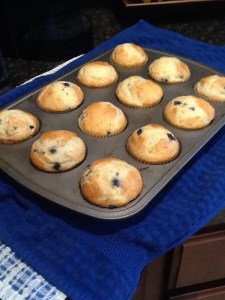 The timer goes off. The muffins have a golden hue mixed with dots of blue. They smell warm and tasty. The family gathers around the table. Glasses are filled with orange juice and milk. Butter is applied to the muffins for those who want it. There is chatter, request for more drink, and even laughter.

 I know this is going to shock you… I have been without my iPhone for two weeks. It finally died during Christmas break. I have a replacement phone on the way, but it is back-ordered. I’ve learned a few things about how a smartphone impacts our daily life.