I have been moved to tears by two movies lately, but I will get to that in a moment.
I do not matter. Nobody really reads my blogs, or notices when I do not tweet, or update my Facebook status. This is my fist year without any coaching responsibilities, and I miss it, but the games go on. ESU 10 will not shut down if I am not there, or even if I move on. I do not matter on a grand scale. But I will get back to this in a moment.
One of the themes that connect the two movies is the importance of the everyday. The importance of finding the meaning in life by our everyday struggles. Whether we write poetry or work hard for our family. These two films express the why behind those struggles and relates the power we have to make each moment matter.
I do not matter, except to a few people, most importantly my family. I have made difficult decisions that I felt would be the best for my family. I strive to create a better life for my wife and children.
I matter to a few students. For all my failures, I have simply tried to empower my students to find their own voice. Have I succeed? Not all the time, not with all the students. But I have tried. Every day.
For whatever reason life has been reinforcing the idea that every day matters. For me, for you, for the people we interact with every day.
As life would have it, I have been reading about the “Butterfly Effect” in a number of different types of books. None of them actually about the true nature of the Butterfly Effect which is connected to chaos theory (even though I feel like I am living out chaos theory at times). My reading material has been about the philosophy behind the idea, the power of a small action to create big effects somewhere else.
I bet life has shown you this effect. Whether it was an interaction at the store with a grumpy employee that ruined your day, or receiving a letter from a former student revealing that one moment that helped them later in life. The small moments make a difference.
To the chagrin of my wife, at the checkout stand I have been making up crazy answers to the ever present, “Did you find everything you we looking for today?” What I find so interesting is not the normal everyday conversation we engage in after my response, but that moment when the employee actually stops and stares at me… and then the smile appears.
Let’s say a butterfly’s wings can cause a tornado, but which flap of the wing caused it? Which moment set everything in motion? Why didn’t the butterfly’s wings cause a tornado five minutes earlier? We cannot predict life; we cannot predict which moment will cause the difference. And maybe that is why we forget the power of our everyday life.
Dirty diaper dropped into the diaper pail. Clean diaper secured. I stand my youngest daughter up so that I can get her pants pulled up in a single motion. She looks at me, spreading her arms out wide. I mimic her move. A single second passes before she falls toward me, trying to wrap her arms around my shoulders with all her strength. Her little hands just reaching my upper arms. I return the motion with my own arms, wrapping her tight against my chest. A giggle escapes her and we release our hug. I set her down on the floor and she is off to her next adventure (usually hollering out her big brothers’ names to see where they went).
Every morning I get my three-year-old daughter up for the day. She grabs her blanket as I lift her out of the crib. She then finds her spot on my shoulder. Her head snuggled into my neck and she whispers, “I take care of you.” Almost everyday I have to just stand there and hold her, knowing too soon she will be able to get up on her own.
If we take the time, we can see and feel those small moments when others tell us they love us. If we take the time, we can create a small “I love you” with an action that is just a part of our everyday routine. If we take the time… the smallest thing can have the most powerful effect in our lives. Take the time.
(This video is for my beautiful wife… remember our concert date?)
“Red light!” Jill looks over the kids. Jason is… falling. He is out.
You are frozen, waiting for the “light” to change.
“Green light!”
You take off, but not too fast, so you can stop with the light change. But your feet want to run, the light is still green. You are torn between letting your feet go, reaching the end before she turns around to change the light, or keeping your pace in control so you can freeze when the light turns back to red.
What color is the light in your classroom?
I recently showed the Ted talk, “Why Videos Go Viral” by Kevin Allocca, from a TEDYouth event. The main point of the talk is about why videos become popular, but Kevin makes an interesting point toward the end of his talk, “No one has to green-light your idea.”
Kevin was talking about creating content on YouTube, but the idea goes way beyond that. I would love to be a student during this time. The opportunities to create and pursues activities that ignite our passions are at our disposal.
And that is where I think educational reform needs to take place.
It is not in technology. It is not standardized tests. It is in turning around and hollering, “Green light!” The underlining paradigm of education needs to change. Students are creating projects and pursuing their dreams without us. They are finding their own way in this world, finding their own success.
Without us.
And I think that is the most important aspect of all of this. School should be the place that empowers students to be able to live their life to the fullest. School should be the place that strengths our society by build community and cultivating our culture values. And one of our most traditional values has always been the idea of success. It is the heart of the “American Dream.” And at this moment in time, we have a greater opportunity to pursue our dreams then ever before. But is school matching the possibility that is present in our society?
We need education to change the light to green.
I would love to hear your stories about how you have been changing the light in your school. Share your stories with me in the comment section.
Technology and education have been at the forefront of my thoughts lately. Last week I got to be a part of a school’s discussion on moving to 1:1 instruction with the iPad for high school students. The teachers shared their concerns, their fears, and their excitement.
I remember being at that junction when I was a teacher at Centura. Yes, as an English teacher I worried about the loss of the book. I wondered how my position as the teacher would be affected in the classroom. Years later, I find myself teaching from an office through technology only.
Yesterday, I got to teach my American Literature class from Centura. It was energizing to be in front of the students. To have the room filled with laughter, with questions, with that energy that comes from a group of people working and sharing. Today, I am back at the office getting the lesson plan tweaked so we can use Socrative during the class.
One of the themes we are covering in the American Literature class is education. We have seen how Frederick Douglass educated himself by tricking street kids in writing contests. Frederick Douglass understood that education was one part of his path to freedom from slavery. Ralph Waldo Emerson revealed in The American Scholar that true scholars hold a powerful responsibility to our world, to reveal truth. Emerson also states that if nothing else, a true scholar has the ability to live and by truly living we learn. My favorite poet, Langston Hughes, stated in the poem “Theme for English B” that,
The instructor said,
Go home and write a page tonight. And let that page come out of you— Then, it will be true.
I wonder if it’s that simple? …
…It’s not easy to know what is true for you or me at twenty-two, my age. But I guess I’m what I feel and see and hear, Harlem, I hear you: hear you, hear me—we two—you, me, talk on this page.
To simply state it; the message has been that true education is a reflection of ourselves and continues our entire lifetime.
But in class we are now reading The Street by Ann Petry. And the message has changed. The book expresses an idea that education is just something we go through to gain a better job that allows us to have more money. I’m not sure this doesn’t reflect what education is today.
And no technology will change that. As no pencil will change it either. Teachers have the power to change the view of education. And yes, tools like the iPad do empower teachers to make a difference, not just for the students, but also for their own love of learning. I’m excited as a teacher for the things I can produce with technology, like my own textbook, or a web app that will help my students learn.
So, why doesn’t my son get his iPod? Because he has been spending too much time with it and is in trouble of not making his A.R. goal this quarter. And it is my job to teach him the balance of using technology. As it is a responsibility of teachers to be that person who sparks real learning in students, as Langston Hughes writes,
I guess being colored doesn’t make me not like the same things other folks like who are other races. So will my page be colored that I write? Being me, it will not be white. But it will be a part of you, instructor. You are white— yet a part of me, as I am a part of you.
That’s American. Sometimes perhaps you don’t want to be a part of me. Nor do I often want to be a part of you. But we are, that’s true! As I learn from you, I guess you learn from me— although you’re older—and white— and somewhat more free.
Truth be told, education makes us free and connects us on deeper levels than any Facebook statues update could. At the heart of learning we become the best of who we are.
Emerson states in the American Scholar “Life is our dictionary.” What are we helping our students write in their life?
In a 2008 study, “What We Regret Most … and Why,” by Neal J. Roese and Amy Summerville, it reveals that our top three regrets, in order, are Education, Career, and Romance. The research basically showed that we regret those opportunities where we could improve our life and that most of our regrets center on what we could have done. Not on what we did.
But why do we let those opportunities go by, both the small and life changing moments?
This morning I helped drop off my children at daycare and school. My second son and oldest daughter rode with me to their school. We got there before my wife, so we sat in the car and they wanted to play our version of “I Spy Alphabet” game. My first instinct was actually to not play, to be quiet and wait. A small moment (by the way Parenting is number four in the above study)… that I didn’t let go. We got to the letter L and laughed the whole time. The rule is to name something you see as you go through the alphabet. My daughter kept hollering out random things. As my wife pulled up “LION!” filled the car.
“Where?!” I hollered in mock surprise. We got out of the car laughing.
But there are big moments, life-changing moments. My current position places me at the edge of change. Technology is always improving, changing, and education is the most powerful aspect I know that positively affects our lives (and the number one regret for people).
Courtesy of Centura Student Angelica
Later this week I get the privilege of attending a teacher in-service for a school that is working on the idea of going 1:1. Last week I got to speak, as a dad and teacher, about my view of technology in education. I am still finding my feet in regards to expressing my philosophical views with my job. Every teacher I have ever had in class or worked with had their own talents. Even though I work with technology all the time, one of my personal goals for my job is to help teachers be at their best. Technology or not. Because the classroom, everyday, is one of the most powerful places in the world. I am proud to be a part of that moment for students, teachers, and education in general.
Education is the number one regret people have… our most powerful regrets are those things we didn’t do, especially with things that would make our lives better.
This post doesn’t have any answers; it is simply a small moment I had to share with you. To maybe plant a seed for your next moment in life, big or small, to not regret it.
In the last 24 hours I got a real look at what technology can do for us in our lives. I will try not to bore you with an extensive look at my day, but I think it is important to share with you how technology can be a great tool for us.
24 hours ago I posted a blog on shoveling snow. The weather didn’t improve and I decided to work from home and that started a great 24 hours.
The Scratch Cat
I needed to communicate with the teachers for both of my class responsibilities, which meant email. But that was not the only email I wrote (as I watched Storage Wars). I sent an email to a TECH student who is interested in app development. I also sent an email to a teacher about the Scratch program she was interested in teaching.
I then had to revamp some assignments for class. The TECHS class wasn’t too much trouble because we were watching informational videos on Java Script that were already posted on Angel. American Lit had to be changed to a purely online assignment.
I was then going to grade assignments for American Lit but got into two conversations about life. One conversation on Facebook and one conversation on Twitter. Both were with former students. The kind of conversations that energize you because they go beyond the basic; “Hey, what are you doing? Nothing. What are you doing?” routine. The conversations covered deep aspects of life (Fatherhood, Highs and Lows of Life).
I finally got to bed just before midnight. I got a little extra sleep because the kids’ school
The Blue Moon Coffee Shop
had a late start because of the weather. I got to drop off my two little girls at day care and then headed to my other office, The Blue Moon coffee shop.
As I drank coffee I was involved in a Twitter conversation about connecting with students on social media sites, sending information about Symbaloo for someone and read a couple of powerful articles.
I headed home so I could Skype into a Social Studies Teachers meeting a colleague (Deanna Stall) was hosting. I demonstrated Socrative to them (a cloud based clicker tool for the classroom).
When my time was up I noticed a friend and colleague (Mr. Badura) was on Skype, so I shared Socrative with him.
I ate lunch (but didn’t tweet about it). 😉
Then I called each of the schools individually in my American Lit course with my iPad using the Polycom app. I spent about 15 minutes with each school covering the guidelines of the assignments, answering questions about upcoming essays, and a few classes got a small tour of the house.
And now I am posting another blog. To build on yesterday’s post, what technology did in the last 24 hours for me was to make small meaningful connections. To share, to laugh, to help, and to make real personal connections with a wide range of people. Now, I will take face-to-face conversations any day, but honestly, what happen in the last 24 hours could not have happen without technology.
We had enough bad weather this morning that I had to shovel snow again. It was easy to remove the snow from the driveway, but it was a chore to remove the shin high snow from the street. Specifically the area around my mailbox.
Clearing the Street
It is probably a city ordinance to have this area cleared, and there was no way the mail person would have been able to deliver our mail tomorrow without me clearing the area for them. To be honest, I was not happy about it. All I have is a snow shovel (Yes, a snow blower will be on my Christmas list next year).
As I started in to the task I remembered that last Friday, when the wind was blowing like crazy, our garbage men placed our garbage and recycling containers next to our garage doors out of the wind. A small action that meant a lot.
A small action… small moments… that mean a lot.
Maybe it was all the snow I was shoveling, but your mind can be free to think when you are working, and I was thinking about how our lives are stitched together by all the small moments we create. All the words we say on a daily basis. Big moments come, but our strength comes from the way we build our lives through the small actions we do.
I know the mail person will not even think about the work I did clearing the snow, but it will matter for them. Honestly, most of the small things we do go unnoticed, yet they are the actions that make our days matter. For us and the people around us. What small thing can you do today?
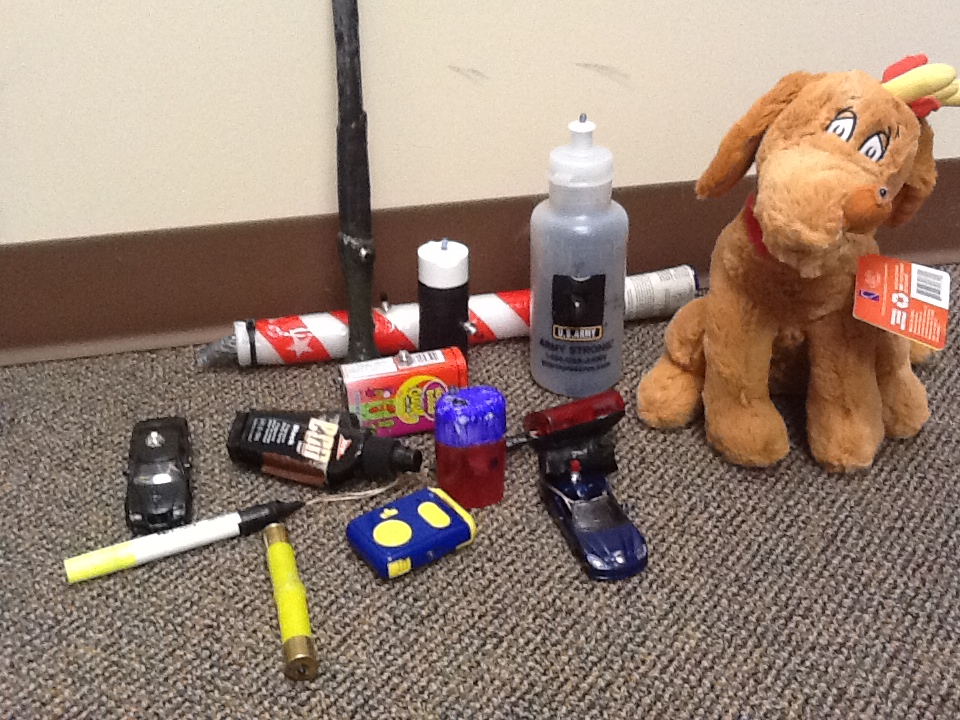
Here are examples of IR Pens, that combined with a Wii remote, software, and a projector you can have a SMART Board anywhere. This project is a part of ESU 10’s TECHS program. The photo shows student constructed IR Pens for this year. The first thing you will notice is the “personality” of each project, a reindeer, two cars, a wand, and a bubble gum container to just name a few.
This has been a tough year as I continue to understand and work with the TECHS class, but these IR Pens are a highlight for me. These represent a deeper aspect of true learning. All the students understand some basic constructs (wiring, Infrared light, design) but they were allowed to express their personalities in the project. Awesome! As educators we strive to help students to achieve that personal connection to learning. When possible, projects can do that. The IR Pens show that. I think the students did an incredible job!
Here is Johnny Lee’s TED talk about hacking Wii remotes.