Tag Archives: mountain

Mountain Range

Over the last two years I have made a number of trips home to Wyoming. Regular readers know why. As I traveled north on I-25 I always enjoyed seeing the mountains in the west. When the sky is just blue, Laramie Peak cuts a wonderful scene against the sky. 

Photo Credit: Marie Coleman via Flickr

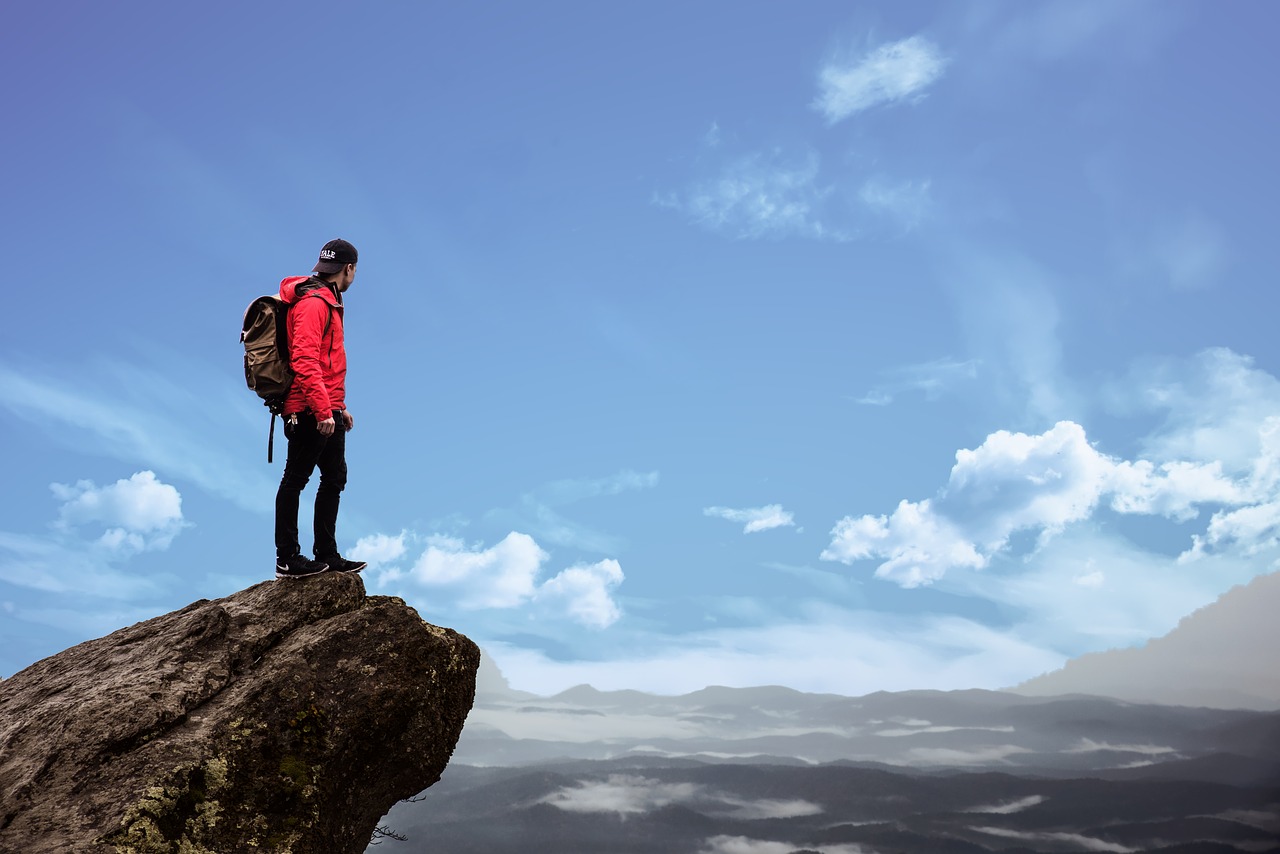
Like many people, I think about how cool the view would be from the top of the mountain.

I am not much of a mountain climber, but there are lots of people who have that drive. According to a number of different sources, about 800 people reach the summit of Mount Everest each year, even though Mount Everest is the deadliest mountain to climb. It has a death zone that starts at the elevation of 8,000 meters. Twelve percent of the deaths over the years are from exhaustion.

On my walk I was thinking about trying to go home this summer, and then I started to think about the past trips and the mountain range (and actually of the handful of poems I’ve written from those trips). In one of those magical moments where ideas lead to ideas and then to connections, I thought about how we use climbing a mountain as a symbol of reaching our personal goals. 

And why the symbolism works.

Everyone loves the view of their goals as they travel the road of everyday living. We think about how great the view of life would be when we reach those goals. But that thought is not enough to motivate most of us to actually put on our gear and start climbing.

I’ll use Mount Everest as an example for reaching our goals.

First is time. On average it takes 6 – 10 weeks to reach the summit of Mount Everest. Part of the reason is to safely adjust to the altitude. 

There are milestones and adjustments when striving for a goal. Be it time, sacrifices, or even self development. Trying to fulfill a dream takes a commitment of time that we sometimes don’t want to give. It’s easier to continue on the highway and look at the goal on the horizon.

Second factor is the cost. Just the license to climb Mount Everest is $11,000 from the government of Nepal. Also, there is the cost of equipment and the Sherpas’ services to reach the top.

The cost of reaching a goal varies for sure. But I am in the red for the total amount I have paid for gas, bookmarks, and postage compared to how much I’ve made selling books, and it’s not even close. 

Then there is the cost of pain, physical and emotional. While climbing Mount Everest, climbers will experience altitude sickness, fatigue, and the weather conditions can change quickly. I can’t even imagine how many times they have to deal with the voice in their head telling them to give up. Sir Edmund Hillary, one of the first climbers to reach the summit, said,  “It’s not the mountain we conquer, but ourselves.”

Isn’t this true for everyone who strives to reach their goals? It is one of the most important reasons to go after our goals. There is a reason why we have a dream. It is connected to our spirit, it is a reflection of who we can be. So, even if we never fully reach the summit of our goals, we become the person we can be by striving for that goal.

It’s easy to just drive past the mountain ranges as we travel this life. Gaze at their majestic beauty. Think about the view from the top, how wonderful it would be, but keep the cruise control on.

Or go after that dream that beckons you. There is an exit coming up that will take you to the base of the mountain. It has always been there, just like the mountain range.

Leave a comment

Filed under Family, Life

I Build Bridges

For a minute, or two, consider how captivating bridges are in our lives, both physically and metaphorically. 

In physical form bridges represent our ingenuity of getting over obstacles. Whether it is a river or two mountain tops, we design bridges to help us on our journey. And then to return home. The wonder of them expands when you consider the style, the personality of the bridges we build. From the simple log laid down by a child to get over a stream, to the The Danyang-Kunshan Grand Bridge in China that covers over a hundred miles, each bridge is unique. Not only in the material used or the architectural design, but also the environment it was built in; the obstacle it was built to overcome.

As I’ve traveled over the years I’ve come to appreciate the bridges I’ve seen and used. I don’t think I am alone in this joy because the idea of a bridge is ingrained in our lives. We understand the importance of reaching the other side of an obstacle, even when it is in our relationships, our opportunities in life. 

We are always told not to “burn any bridges”.

The advice is good. All of our relationships are metaphorically connected by the bridges we build, by the obstacles we overcome in the relationships, and each connection has its own style influenced by the moments we share together. Burning a bridge is a devastating step in any relationship. (I will acknowledge and confess that there are bridges that do need to be burned down, but that is for another time.)

Then, there are the bridges we build that we never get to see in use. I know because I build bridges. I am a writer. 

Like all artists I create a bridge when I write a blog post, a book, or a poem. I construct a way for readers to find their way to my side of the moment. We connect through the words I use to build a bridge between our shared lives, our shared moments, or to allow the reader to explore a new view from my mountain top. 

All artists do this. How do I know, because I am a reader. I listen to music. I visit museums. I have walked on bridges created by all kinds of artists. I go back in time when I read Wordsworth’s poem “The World Is Too Much With Us,” and feel the same angst about society today. I could spend all day at any type of museum. As part of our honeymoon my wife and I went to the Art Institute in Chicago. (Yes, we went to a Cub’s game, too.) 

I always get choked up when I hear this line from the song “Humble and Kind”: 

Consider for a minute, or two, how powerful bridges are to the fullness of our lives. Whether we are driving on a family vacation, listening to a new song by our favorite artist, or even reading a blog post by someone new; each bridge is built with care and a unique style. I know because I build bridges, I am a writer.

2 Comments

Filed under Family, Life

Motivation

mo·ti·va·tion [moh-tuh-vey-shuhn] noun

  1. the act or an instance of motivating,  or providing with a reason to act in a certain way (dictionary.com)

During a conversation with a colleague, the idea of motivation in the classroom came about.  This discussion coincides with some ideas I have been thinking about regarding how we reach our students.  So, I am going to try to express a complicated web of ideas with the center being motivation.

As a teacher I have been frustrated.  I have stood in front of my room looking out on my students’ faces talking to myself, “How do they not see how great this book, or poem, or lesson, is?”  Sometimes, as teachers, we take for granted that everyone knows how powerful learning is.  But if we look at popular culture, it will remind you that they don’t.

Idea one: The Mountain

Let’s use a metaphor for a second. If we view education as a mountain, we understand that to see the spectacular view from the top we must climb.  And that climb is hard at times.  Even an expert mountain climber (or a well educated person) needs a hand to get to the top.

Image by Pete Linforth from Pixabay

Sometimes we need to remember that our students haven’t made this climb before.  Sometimes we have to reach out to them and show them the way to the mountaintop.  The view is incredible; they just don’t know it yet.

Idea Two: Practice

What if the classroom was more like practice?  Take a second to think back to what practice was like for you. How many times did the whistle blow?  How many times did coach go off on some kind of motivational rant?  Sometimes coach got on your case, other times a “nice job” was all it took to keep you going.  You were pushed, you were challenged, sometimes you were down right dog-tired yet felt great.

What does a typical classroom look, sound, feel like?  I understand the difference in the environments, but why can’t we match the energy of practice to a classroom?  The techniques and tools are different, but not what motivates a person.  In an interview on Focus on the Family for his book, coach Joe Gibbs stated that a good coach finds what works with his athletes to motivate them, be it a challenge or a simple comment like “good job.”

Everybody needs motivation; I found it as a coach when we successfully performed on the field.  As a teacher I found it in the light-bulb moment.  We all need motivation, a helping hand.  Not because we don’t know of the importance of our jobs, but because sometimes the climb is just hard.  And we forget what the view is.

Courtesy of Flickr user rbbaird

Leave a comment

Filed under Education, Life