For the last couple of months, I have been untying my shoes when I take them off. Yes, that means I have to tie them when I put them on.
Yesterday I spent almost an hour trying to find the right word for a poem. A single word. I was working with meaning and syllable count for that word, but still, I spent time finding the right word.
My screen time is down almost 15%.
Over the last 11 weeks my steps have jumped up over 3,000 more steps a day.
I’ve heard the quote, “How you do one thing is how you do everything,” used in movies and TV shows lately.
Each day we have 24 hours. Everyone.
How we use it is the fundamental factor to the quality of our lives. Even when bad things happen, or unexpected challenges, it is our responsibility to decide how we deal with the time we are given.
I have decided to untie my shoes when I take them off.
On day two Robert challenged us to write a poem “from where I am sitting.” The idea was to pay attention to the world around us. My poem stays true to the heart of the prompt, but was written during a walk.
“After the Rain has Stopped”
I am walking
after the rain has stopped.
Mix of earth and evening
sits heavy in my lungs.
Grey clouds fading back to white
releasing the gloom
of the day.
The sun’s last rays
play with the mosaic blues
above me.
A painting even Michelangelo
would sign his name to.
The promise of spring
tickles my nose
and my heart moves to the
music of the birds
perched in the trees,
as if they are God’s choir.
This street morphing
into an aisle between
the pews of hope
and wonder.
–
I am walking
after the rain has stopped.
Finding myself
In the middle
of a sacred liturgy.
There are a number of reasons I wanted to discuss the creative process of this poem.
First, nature is a powerful source of inspiration. Robert Frost, William Wordsworth, and so many others have drawn inspiration from nature. Be it from walks (even Stephen King walks) or quiet moments in nature. Robert Frost’s “Stopping by Woods on a Snowy Evening” is an example of how deep a moment in nature can be.
If you feel like you have writer’s block, I suggest taking a walk in the park with the focus paying attention to the world around you, like the prompt for the poem. You will be inspired.
Second, I will be honest here… the idea of this poem was actually written the night before the prompt. My Notes app is filled with poetic lines, random thoughts, and even full first drafts of works. As life aligns sometimes, it was a perfect fit for the challenge. I reworked the draft from the app, even thought of using the viator poetic form for the final draft, but liked the free verse flow of the descriptions.
But here is the important point, being able to draw on ideas from notes or drafts. Besides my app, I keep notes, write single lines, and even draw drafts of ideas on any paper I can find when inspiration hits. At this moment, I have a single line in my Notes app that I can’t get out of my mind, but I haven’t been able to cross that inspirational bridge to create something yet. That is cool, and yes, frustrating. But I am excited for that moment when the line becomes more.
The third aspect is the use of imagery to bring forth the theme of the spiritual feeling I had during the walk. The use of literary elements is the art of poetry, of writing. Literary elements allow us to describe all the abstract feelings we have as humans and allow us to share those feelings with others in a way they can relate to. That is the bridge art builds for us. To connect us. To reveal the powerful aspect of this life. We are never alone in our emotions, both positive or negative.
I hope you enjoyed this small series of my creative process for a few of the poems I wrote for the Poetry a Day challenge. Share your process or thoughts in the comment section.
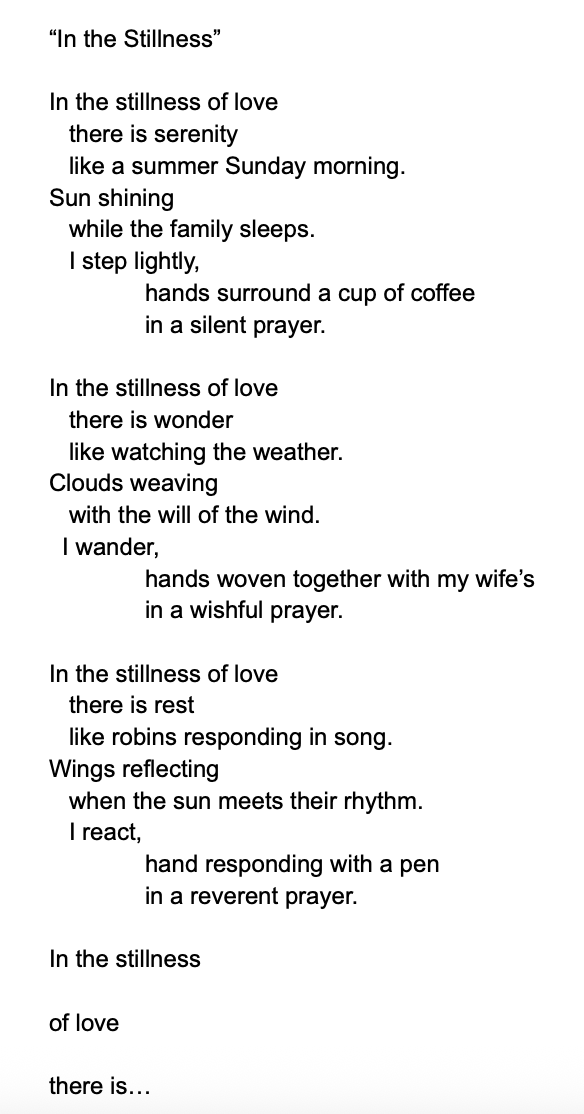
One of the most creative poetic forms is the nonce. Which is a poetic form the poet designs for a specific poem. The poet decides the rules for a poem. On day 20 the prompt was rest. I had a line start in my head, “In the stillness of love.”
And I wrote this poem. I am using the photo option because I couldn’t figure out how to get WordPress to keep the line breaks correct.
The idea of the rules came to me as I started the first draft. The first rule was that I would use a descriptive word followed by a simile. Through the edits, I had to work with both the descriptive word and a creative simile to match it. The third stanza went through a ton of revisions.
As I rewrote my ideas, I noticed that I had unintentionally used alliteration in the first stanza. So, I added that as a rule, and had to rework the second and third stanza again. I didn’t want the alliteration to be overbearing, but wanted it to be clear as the descriptive word was introduced in the second line.
I also went with the imagery of my hands in a type of prayer. Again, this idea came from the first stanza. Which happens sometimes, the base idea is easily transcribed on the page, then the poem is constructed from there. Honestly, the first stanza is almost as is. It is the example of the power of the muse. The other two stanzas took work.
I also like using line breaks and spaces in my more free form poems. It is something I did when I was a younger poet. I like how spaces and tabs can create flow, tells the reader to breathe. As I reworked the poem, the line breaks started to materialize as I scribbled on my yellow legal pad. But the final rules for the look was cemented when I transferred the poem to a Google doc. I could firmly set the rule for spaces and see how it moved on the page.
Because of the challenge of writing and posting a poem in a day, I went with the ending as I wrote it. I am unsure of the ending at the moment. I may revise it later, but the poem is presented here as it was written for that day.
Have you ever designed your own rules for a poem? Share your experience in the comment section.



 It is all Connected