Category Archives: Education

The Why

There has been a kind of running joke between my students and me about how I deconstruct Disney movies with my kids to reveal the “deeper” meaning of the film for them.  Actually, I do that, but that’s not the purpose of this blog.

I love to hear, “My brain hurts.”  I think I do a good job at creating lessons that reach a deeper level for the students.  Many times my students do better on their Literacy Skills AR test than the Reading Practice test.  But, at some point a student will ask, “Does everything have to be so deep?”

Yes, yes it does.

OK, maybe not so deep but I think we have to have a serious WHY to what we do.  Teachers have to answer that question all the time, but maybe it is something to really consider.  And not just for a lesson, but for our lives.

In school, sometimes we have to practice a skill, like math or welding.  Sometimes we have to learn new vocabulary so that we can look at a subject on a deeper level.  And sometimes a lesson is just fun or relaxed.  Many times in school the WHY is based on test scores or grades.  A look at those parameters and learning is for another blog.  But schools have to have some measurement and we will leave it at that for now.

Let me give you a stat: “Thirty percent of college and university students drop out after their first year. Half never graduate, and college completion rates in the United States have been stalled for more than three decades,” from US News and World Report.

Is the WHY of school to prepare students for college?   Or should it be to help them live up to their greatest expression of their talent and dreams? WHY are we doing what we are doing?  I know that I am in a unique situation that lets me investigate education from a different aspect while also being in the “classroom” dealing with the real world of teaching.  Being at this intersection is frustrating and motivating.  I would love to change education, but in reality I am not much of an influence.  But like you, I have a classroom, students, and a life to live.

This year I had one of those great teacher moments when a former student tagged me in a photograph on Facebook.  The photo was of a slide that had graffiti scratched into it, the worst kind.  This former student is a father now and was spending time with his son at the park when he came across the graffiti. Part of his post, “Made me think of the book The Catcher in the Rye. Kids and their innocence.”

What we do in the classroom matters.  What we do in life matters.  It might make your brain hurt, but I ask you to answer your own WHY questions this summer.

2 Comments

Filed under Education, Life

Choice or Indecision?

As stated in Barry Schwartz’s TED Talk, too many options can be paralyzing.  We all feel empowered by choice.  It gives us a sense of control of our lives, of our own happiness.  But I agree with Barry Schwartz’s there is a negative side to choice.  Whether it is too many choices, or an unexpected choice, we don’t feel empowered.  We feel frozen and unsure.

Personally, I went through this last week.  I was presented with an unexpected opportunity to return to the classroom.  Understand; this was a choice that was totally unexpected.  It challenged me to think about my future: where did I want to be in five years?  Where did I want to be next year?  Instead of feeling free and honored to be considered for the position, it froze me.   I decided to stay with ESU 10 at the moment because I needed to finish what I had started.  Where will I be in five years?  I can’t say for sure, but that is for another blog.

But I’m starting to see this paralysis in education.  Many schools are considering going to a 1:1 environment with iPads.  I think that is awesome, but there is a hurdle that needs to be addressed: app choice.

7415 free apps in the area of productivity.  How productive would I be sifting through all those choices? I know what you are thinking; use the search option.  OK.  I’ll use the keyword “Grammar” (Hey, I’m an English teacher).

Results: 720 apps, both free and paid.

As the landscape changes in the classroom with mobile technology, it is good to be aware of different hurdles that a school, a teacher, or student may face.  In this case the option of choice regarding apps.  A great benefit of mobile devices is the ability to personalize content and the learning experience a student has through the apps and tools provided for them. But which app to choose? There is not a “right or wrong” answer here, but Barry Schwartz’s does present a philosophy to consider.

We are in a transitional period, a reconstructing of our “fish bowls” you might say. It is not easy, but it is exciting to be in the mix of this change.  What will education look like in 5 years? The choice is ours…


Leave a comment

Filed under Education, Life, Technology

Grand Idea

In the month of April I had the privilege of presenting at two outstanding conferences: Mobile 2012 and NETA.  My goal was to inspire ideas on how to be a mobile teacher:  how to use the iPad to bring the world into the teacher’s classroom.

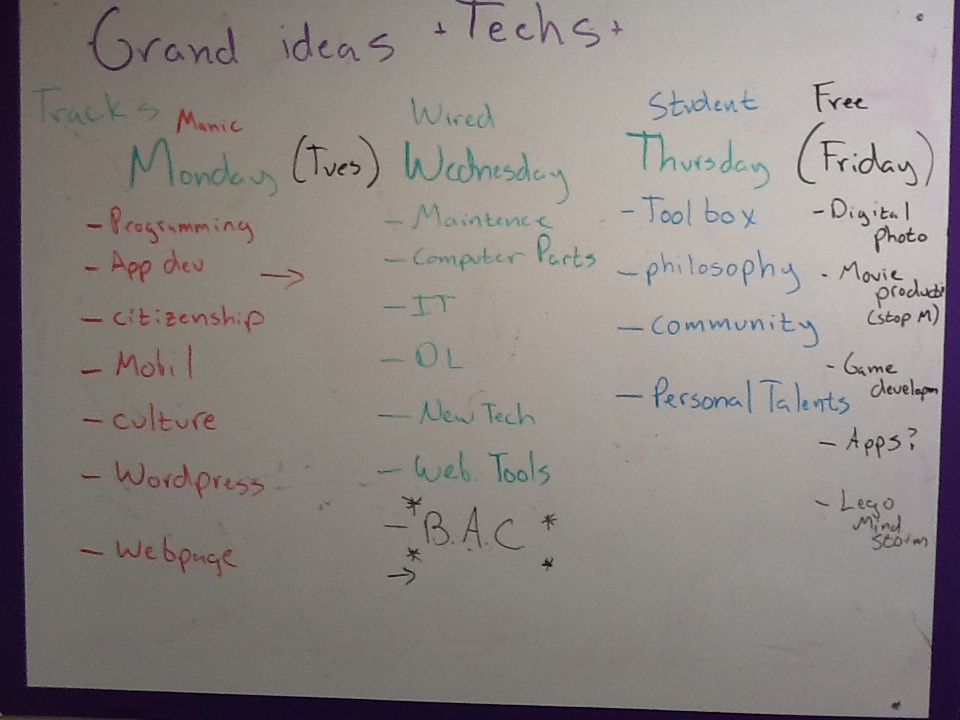
This week at work I am brainstorming ideas on how to make my CCC and TECHS class better.  I’m calling them my “Grand Ideas.” I filled my whiteboard with them for the TECHS class.

Grand ideas are exciting.  When we attend any conference, we come away with these ideas.  We feel energized.  We feel inspired.  The next year is a blank canvas for us. We are ready to take those ideas and create new lessons, but…

Grand Ideas are scary.  They push us out of our comfort zone.  We know the new lesson might just fail.  That is OK.  Run with your Grand Idea.  Fuel that inspiration by striving for it.  It will take work, a step back sometimes, but for teachers our lessons are our creative process.  The lessons are works of art for us.  But you have to pick up the brush.

One secret to success is to tell someone your goals, share your Grand Ideas with others in the comment section.  Contact me if I can help you in any way.  Just imagine what your classroom will be like next year…

Designed with PicLits

1 Comment

Filed under Education, Technology

FAIL

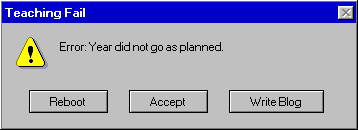
What a year… As the academic year winds down I have time to reflect on how much I failed this year.  But I have learned some interesting things about education and myself through these failures.

The first lesson:  Teaching is really about the relationships we build.  By teaching from an office over a codec system 100 percent of the time has reinforced how important personal interaction is.  For the students and the teachers.  And it is not just the connections we develop during the class; it is the daily vibe of school.  The interactions between class, lunchroom banter, and the questions before and after school.

I was unprepared for the drastic change in the environment of my classroom.  Trying to remember names, understanding strengths and weakness, and interacting with students to understand their personality.  I failed.  I have a few ideas for next year that I will try to use to create a better personal connection with the students.  Because, at the heart of learning, is the relationship between student, teacher, and the subject matter.

The second lesson: Technology is not a separate component to learning.  It is not a bonus feature to bring into the classroom and use because it is cool.  I failed in the use of technology this year.  Part of my teaching responsibilities is the TECHS course that ESU 10 has developed over the last seven years.  Since the class is centered on teaching all aspects of technology I thought I had to use technology everyday.  Which isn’t my personality (lesson three).  So, I saturated the class with technology instead of using the best tool for the lesson.

The third lesson: Teaching is an art.  I know that there are strategies that support an effective classroom, but I think those strategies work because they support a teacher’s personality. For the TECHS class, I used everything that was in place from last year (I did add some lessons but I used the timeline, test, and other assignments that were already set up unchanged). And I failed.  It was like trying to dance with another person’s shoes on.  Hard to find your groove.

Ironically, Mr. Stritt told me how each year the class changed, lessons were moved, new ideas added.  But I tried not to change it, to follow the great lessons that ESU 10 had built.  But it wasn’t mine.  It didn’t fit my personality.  Which connects back to lesson one; learning is a relationship between students, teachers, and the subject matter.

The fourth lesson: Failure can be a good thing.  I have learned a lot this past year.  Would I do it again? Maybe not, there were some hard times for me.  But to have the opportunity to come to a deeper understanding of education was worth it.  I am excited to see what I do with my failures next year.  I hope I can write a success blog next year.

Leave a comment

Filed under Education, Technology

Snap Bracelets

My two little girls were excited this morning to go to daycare.  Fridays are show-and-share days and they had something cool to show today.  Snap bracelets.  I gave the girls the snap bracelets last night.  The girls had no idea how they worked until we showed them.

I brought out the bracelets straighten out, then held my girls’ hands and then snapped the bracelet on to their wrist.  They responded with a wide-eyed expression that then turned into laughter.  My youngest hollered, “Again!”

For the next five minutes my wife and I snapped the bracelets on our daughters’ wrist, on our wrist, and of course even the older ones had to get into the fun.  The girls soon wanted to snap the bracelets themselves.  My youngest had a tougher time getting enough force behind her snap to get the bracelet to curl around her arm, but she did get it a few times.

My second daughter, though, took off with it.  She had it on her ankle, “Look daddy, look at the lizard on my foot!”  She had it on her upper arm; she was snapping it on her brothers’ wrist.  And she had to take it to bed with her.

This morning they had their snap bracelets on and excited to share with their friends at daycare.

As life does, it got me thinking about education.  Without getting too bogged down with deep issues, the snap bracelets are a great example of learning.  When my girls were presented with the bracelets they recognized the animals, but did not understand the apparatus the animals were sitting on.  We “told” them what it was.  They still didn’t totally understand, but they knew what jewelry was and this didn’t look like a bracelet.  Then my wife and I demonstrated how it worked.  It was the coolest thing they had seen.  My girls understood, but weren’t ready to do it themselves, so we demonstrated for a while then handed the bracelets off to them to play with.

Now comes the powerful aspect.  My youngest daughter could make it snap once and awhile, but she still needed assistance.  Plus, she only wanted it on her wrist.  That’s were she is as a two-year-old.  But my second daughter, almost a year and a half older, took off with the snap bracelet.  Understanding the concept, she tested it out on her ankle, on her upper arm, on her siblings.

Isn’t that what we want in learning?  As teachers we are there to show our students the subject matter (a poem, cell division, drawing perspective).  We can “tell” them stuff, but once we show them how powerful the subject is, to practice the concept with them until we let them go to expand their own learning.  To test the ideas out, to experiment with the concept, to create a new idea… to learn.

Leave a comment

Filed under Education, Family, Life

Using iBook for Lecture Notes

This is the semester that I teach American Literature for CCC Grand Island via distance learning.  For the first time we are reading Tuesdays With Morrie. Instead of creating my notes on a notepad or with 3 X 5 cards, I decided to use the highlight / note option in iBook.  Plus, I decided to project the book on the screen as I lectured and presented notes on the whiteboard.  Day one went well.

My Lecture Notes

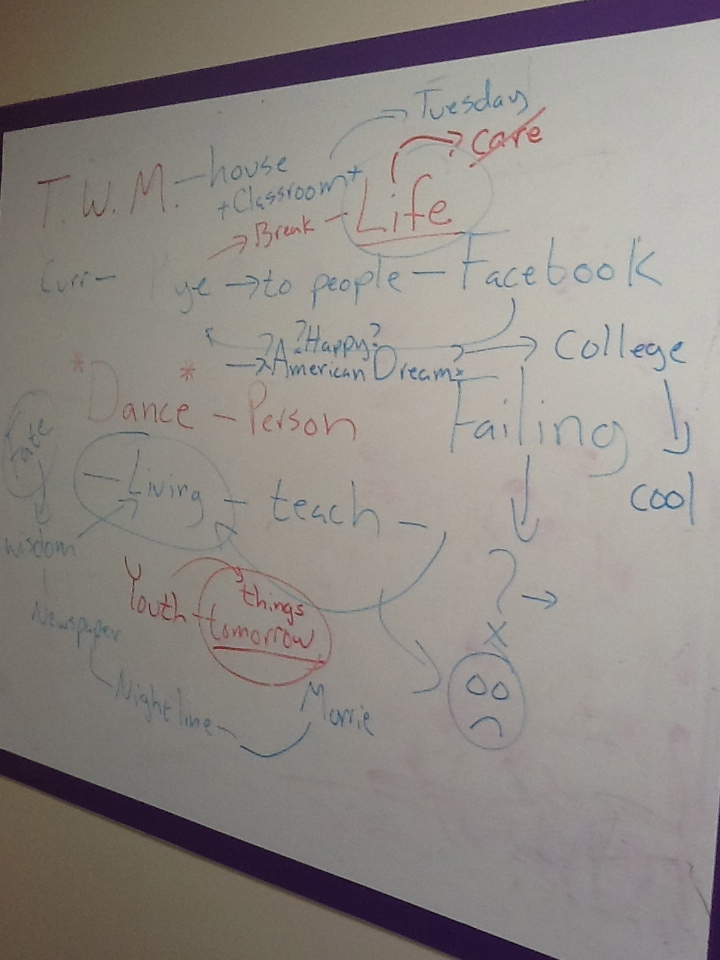
As you can see above, my “notes” are crazy and always have been, even in my traditional classroom. The iPad 2 added some unique aspects to my delivery. A cool aspect was integrating YouTube videos into my lecture.  I love connecting pop culture references to my lessons.  As I formulated my notes, a couple of references came to mind and I cued them up on the YouTube app.  Then, placed a cue in the notes when to show them.  With a swipe of my fingers we went from book to video (slight buffering).

Another aspect I liked was that, in most cases, my notes did not hide the highlighted text, so the students could easily see both.  This didn’t happen 100 percent of the time, but over all both were visible.

The rough spot was me.  First, I am use to having my notes on paper or 3 X 5 card, and would have the same craziness on my own notes as you see on the whiteboard. That is the way I think (and usually talk, but I get to the point).  Also, my timing was not perfect in switching from me to the book.  Not a big issue, but I found myself writing on the board when the book was still on the screen.

Talking with a few of the students after class, they said they liked the approach.  They said that seeing the highlighted sections helped.  They also enjoyed the videos; it allowed them time to think and presented a different insight to an idea in the book.

I hope to collect some quotes from the students (an assignment they have) and use those in the lecture as discussion points.  Overall, I like the ease of using the book with the highlights and notes imbedded in the text.  Plus, being able to use one of my favorite tools, pop culture allusions, adds some fun to my lecture.

Share your story of how you are using the note and highlight option in iBook in the comment area.

A sneak peak at the book if you haven’t read it.

Leave a comment

Filed under Education, Technology

Mobile 2012 Reflections

As the weekend winds down and I get some time to reflect on the Mobile Learning Experience, a couple of things come to mind right away.

Point One: The energy from the conference was intense.  The conference was big enough to meet a new person at every breakout session, yet intimate enough to make real connections with people.  Even the schedule worked into this with the meals.  I was able to sit with my colleagues, yet have new people to meet at every meal.  The keynotes were also an integral part of the energy.  Each message was connected to the conference, but unique to each keynote.  I walked away with different ideas because of each speaker.

Point Two: The power of mobile devices. The first aspect is from Graham Brown-Martin’s keynote, which is we are still not tapping into the power of mobile technology.  We are using a technology designed to be mobile in an immobile environment. Now, what educators and schools are doing with them is awesome!  I’m pushing the idea farther, as I was thinking during Graham’s keynote and tweeted the idea that teachers use Mondays as a “Keynote” day, then, let the students go the rest of the week.

I understand that wouldn’t work all the time, but it brings up the second aspect of the mobile devices and technology: options.  There is a time for lectures (think about how powerful the keynotes and breakout sessions were), a time for worksheets, a time for tests even.  A buzzword right now is differentiation.  Simply put, options.  Mobile devices equip both students and teachers with that.  As an example, I will use simple story structure as a lesson.  In class we might read, listen, or even watch a YouTube video of the story.  I would have some vocab, which I could have a stack of flashcards for them to study, or even have them design their own.  Then, allow the students to show they understand story structure by writing a story, filming a story, or creating a cartoon.  All of which can be done on a mobile device.

Which moves me to the third point: the Teacher – Student relationship.  I started an interesting discussion about app development for teachers between breakout sessions, but I didn’t get the opportunity to finish.  Understand this discussion had the chance to be one of those incredibly deep pedagogy challenging discussions, but I never had the chance to bring it up again.  At the beginning, my inquiry was on the idea of equipping teachers to be able to build apps that would help students in their study of a lesson.  The opposite side was that the students should build them.  I don’t disagree with that, but one aspect I see of technology is the empowering of teachers to be what they went into this profession for, to teach.  Teachers can be the experts again of their field.  If fostered correctly, teachers should be the experts of the curriculum, not the textbook or a website.  The “options” available to connect to the content pushes teachers to raise their game.  And that, as a professional, is exciting.  Our jobs are changing.  Our challenge is to actually design a learning experience that gives students the tools and motivation to live by the highest expression of their talents.

Mobile 2012 was an incredible opportunity for me as a teacher.  I cannot wait to hopefully be a part of Mobile 2013.

Leave a comment

Filed under Education, Student Work, Technology

Keep the Fire Burning

The 2012 Mobile Learning Experience has been an incredible opportunity for me as an educator.  The sessions and face-to-face conversations have ignited ideas that I can’t wait to try.  I also had the privilege to present a session, which allowed me to examine the tools and ideas I use in my classes.  My goal for the presentation was to hopefully generate one idea for the people who attended.  I am excited to continue building relationships with the people, that up until now, I have only known through Twitter.  I am sure many of the educators are feeling on fire, full of ideas, and then….

Monday morning.

How do we keep the fire burning?  Like any fire, you need to keep it fueled and give it space to burn.  And the first step is to take one of the ideas and just try it.  Even if the first attempt fails, it still sparks our passion because we want to do well.  The first step is the hardest, but is needed if we want to keep the fire going.  So, when Monday morning comes be ready to fuel the fire and try a new idea.  Who knows what stories you will have for us next year!

Leave a comment

Filed under Education, Technology

Student Work

The following slide show is a collection of pictures from students revealing a look at the father – son theme in The Natural.

The following is a student presentation. (Click on presentation to advance)

Leave a comment

Filed under Education, Student Work

Student Essay

I wanted to showcase some of my students’ work over the next couple of weeks. The first is Brooke, an American Literature student.  She is usually quiet in class, but she has a tremendous talent with the written word.  Here is her essay over the book The Street. If you get the chance, please leave her some feed back on her essay.  Thank you.

Money: The Downfall of Mankind

Throughout life we are constantly moving. Shoving our way through crowds stomping on dreams already left shattered on the pavement. Regressing, sliding backwards until we stumble over sidewalk cracks or other people passing. No matter which direction we move in we experience those moments that completely turn everything around. Moments of impact where we finally collide with all that we are and what we will become when it’s all over. These collisions shape us. They are the moments when everything falls together and the lesson to be learned is directly in front of us. Some learn to appreciate these moments while others flee from them. On the streets of Harlem people are always avoiding these moments of impact for fear that any realization will send the walls they’ve built crumbling around them. None of them have the strength left to pick through the rubble to rebuild. They’ve already suffered too much. The source of their suffering: a fragile paper dollar.

This fragile piece of paper distorts reality, lifts and slays hope, and defeats the downtrodden. Lutie Johnson and her son Bub are subject to the supremacy of the dollar along with everyone they cross paths with. Every aspect of their life relies on whether or not they can afford to live. Lutie’s first trial began with her husband Jim. Employment is difficult for black men to find and the only work offered is demeaning. They find themselves drifting along surrounded by their own inferiority. Strong, courageous men shrink in the face of money, for it taunts them constantly reminding them of their inadequacies. Jim had said, “Don’t they know if I knew how I’d change the color of my skin?” (Petry 30). As Jim sat back, his pride crushed, Lutie found a job far from home in America. Ignoring the warnings of Mrs. Pizzini who believed, “It’s best that the man work when the babies are young. And when the man is young. Not good for the women to work when she’s young. Not good for the man” (Petry 33). Unfortunately money made the decision for this family before they had any clue what they were heading for. Money is a necessity in this life, aware of its own authority it curls around the fate of families who can’t make ends meet.

In the Chandler household Lutie becomes aware of the American Dream. The Chandlers have paper stacked in every item in their home. It struts around in their clothes, furniture, and conversation. Revealing its crucial importance and persuading all that it’s truly invincible. Conversation in the Chandler home revolved around, “Richest damn country in the world—Always be new markets. If not here in South America, Africa, India—Everywhere and anywhere—Hell make it while you’re young. Anyone can do it—Outsmart the next guy. Think up something before anyone else does. Retire at forty” (Petry 43). The reality of this is not everyone can make money, and this is made obvious in the statement that follows. It’s extremely contradictory to say that anyone can make money, but outsmarting others is necessary to do so. White people made sure colored people were easy to outsmart by allowing them absolutely nothing. Paper constructs this complex competition where only the strong can survive and unfortunately the definition of strong is white men who oppress others to quench their own thirst.

The result of this dream sparkles in the minds of rich white folk, but for all left out of that category it barricades desires leaving only a minute, dull lifestyle. A lifestyle that caused Mrs. Hedges to transform her home into a whore house after being burned and spat out by the world she was circumstantially born into converting her into the piercing, snake lady; a lifestyle that turned Mr. Jones, the super, into a tall, solemn, devilish creature; one that turned Pop into a lonely alcoholic; turned Min into a shapeless, meek woman; Junto into a greasy, squat man; Boots Smith into a numb, angry, womanizing cat man filled with stealthy manipulative tendencies; and all the other faceless creatures of the street into dark shadows sliding along with resigned expressions. Money has kept all these people fearful and imprisoned. Lutie had said, “I don’t like mountains, I get the feeling they’re closing in on me” (Petry 160). The environment Lutie inhabits is always pressing in on her shoving out any sunlight, making her feel small, incompetent. She cannot escape this prison money has locked her in. All she can ever hope for is limited space and consuming darkness. This consuming darkness forces Bub to sleep with the light on in the lonely apartment, and grown men to stand outside Juntos bar staring into the light that warms the building leaving it secure and full of life. They stand staring into the lives they wish they could have, into the dreams they’ll never have the chance to fulfill. The kinds of jobs colored people receive cannot pay, or even come close to paying for anything more than the rent of a broken, dim apartment and measly quantities of food and clothing. All these people are merely just dark, shadowy figures “silhouetted against the light” (Petry 186).

People who weren’t worth anything to the rest of the world were shoved into crowded streets with decomposing buildings, and darkness creeping around the corners seeping into lonely apartments. No one living in these horrid environments could stand a chance against them; eventually the walls would press in to crush what’s left of their hopes. Money forced them to work petty, self-loathing jobs with long hours in order to scrape in just enough cash to pay rent. It kept them from building relationships or self-confidence. Everyone on the street is fighting for themselves alone in hopes of escape; the only relationships that exist are social contracts. The only goal is survival and these people will stoop to any level to make it out with their lives. Money turned Lutie Johnson, a caring mother and confident strong woman, into a wicked murder who deserted her son and ran from the law. It turned a young, happy Bub Johnson into an insecure, greedy, and dishonest boy. How can anyone possibly escape the street, when all it does is pull you back to remind you it is exactly where you belong?

Throughout life we are constantly moving. No matter which direction we move in we experience those moments of impact where we finally collide with all that we are and what we will become. They are the moments when everything falls together and the lesson to be learned is directly in front of us. Some learn to appreciate these moments while others flee from them. On the streets of Harlem people are always avoiding these moments, for none of them have the strength left to pick through the rubble. They’ve already suffered too much. The source: a fragile paper dollar.  Money produces two kinds of people those who have it and those who don’t. The ones who have it become greedy and unappreciative stealing what they can by repressing the weak; those who don’t have it cannot afford to live period. If our lives are weighing heavy on a fragile paper dollar, what happens when the paper tears?


Leave a comment

Filed under Education, Student Work