Monthly Archives: April 2012

FAIL

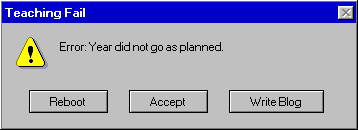
What a year… As the academic year winds down I have time to reflect on how much I failed this year.  But I have learned some interesting things about education and myself through these failures.

The first lesson:  Teaching is really about the relationships we build.  By teaching from an office over a codec system 100 percent of the time has reinforced how important personal interaction is.  For the students and the teachers.  And it is not just the connections we develop during the class; it is the daily vibe of school.  The interactions between class, lunchroom banter, and the questions before and after school.

I was unprepared for the drastic change in the environment of my classroom.  Trying to remember names, understanding strengths and weakness, and interacting with students to understand their personality.  I failed.  I have a few ideas for next year that I will try to use to create a better personal connection with the students.  Because, at the heart of learning, is the relationship between student, teacher, and the subject matter.

The second lesson: Technology is not a separate component to learning.  It is not a bonus feature to bring into the classroom and use because it is cool.  I failed in the use of technology this year.  Part of my teaching responsibilities is the TECHS course that ESU 10 has developed over the last seven years.  Since the class is centered on teaching all aspects of technology I thought I had to use technology everyday.  Which isn’t my personality (lesson three).  So, I saturated the class with technology instead of using the best tool for the lesson.

The third lesson: Teaching is an art.  I know that there are strategies that support an effective classroom, but I think those strategies work because they support a teacher’s personality. For the TECHS class, I used everything that was in place from last year (I did add some lessons but I used the timeline, test, and other assignments that were already set up unchanged). And I failed.  It was like trying to dance with another person’s shoes on.  Hard to find your groove.

Ironically, Mr. Stritt told me how each year the class changed, lessons were moved, new ideas added.  But I tried not to change it, to follow the great lessons that ESU 10 had built.  But it wasn’t mine.  It didn’t fit my personality.  Which connects back to lesson one; learning is a relationship between students, teachers, and the subject matter.

The fourth lesson: Failure can be a good thing.  I have learned a lot this past year.  Would I do it again? Maybe not, there were some hard times for me.  But to have the opportunity to come to a deeper understanding of education was worth it.  I am excited to see what I do with my failures next year.  I hope I can write a success blog next year.

Leave a comment

Filed under Education, Technology

Snap Bracelets

My two little girls were excited this morning to go to daycare.  Fridays are show-and-share days and they had something cool to show today.  Snap bracelets.  I gave the girls the snap bracelets last night.  The girls had no idea how they worked until we showed them.

I brought out the bracelets straighten out, then held my girls’ hands and then snapped the bracelet on to their wrist.  They responded with a wide-eyed expression that then turned into laughter.  My youngest hollered, “Again!”

For the next five minutes my wife and I snapped the bracelets on our daughters’ wrist, on our wrist, and of course even the older ones had to get into the fun.  The girls soon wanted to snap the bracelets themselves.  My youngest had a tougher time getting enough force behind her snap to get the bracelet to curl around her arm, but she did get it a few times.

My second daughter, though, took off with it.  She had it on her ankle, “Look daddy, look at the lizard on my foot!”  She had it on her upper arm; she was snapping it on her brothers’ wrist.  And she had to take it to bed with her.

This morning they had their snap bracelets on and excited to share with their friends at daycare.

As life does, it got me thinking about education.  Without getting too bogged down with deep issues, the snap bracelets are a great example of learning.  When my girls were presented with the bracelets they recognized the animals, but did not understand the apparatus the animals were sitting on.  We “told” them what it was.  They still didn’t totally understand, but they knew what jewelry was and this didn’t look like a bracelet.  Then my wife and I demonstrated how it worked.  It was the coolest thing they had seen.  My girls understood, but weren’t ready to do it themselves, so we demonstrated for a while then handed the bracelets off to them to play with.

Now comes the powerful aspect.  My youngest daughter could make it snap once and awhile, but she still needed assistance.  Plus, she only wanted it on her wrist.  That’s were she is as a two-year-old.  But my second daughter, almost a year and a half older, took off with the snap bracelet.  Understanding the concept, she tested it out on her ankle, on her upper arm, on her siblings.

Isn’t that what we want in learning?  As teachers we are there to show our students the subject matter (a poem, cell division, drawing perspective).  We can “tell” them stuff, but once we show them how powerful the subject is, to practice the concept with them until we let them go to expand their own learning.  To test the ideas out, to experiment with the concept, to create a new idea… to learn.

Leave a comment

Filed under Education, Family, Life

Using iBook for Lecture Notes

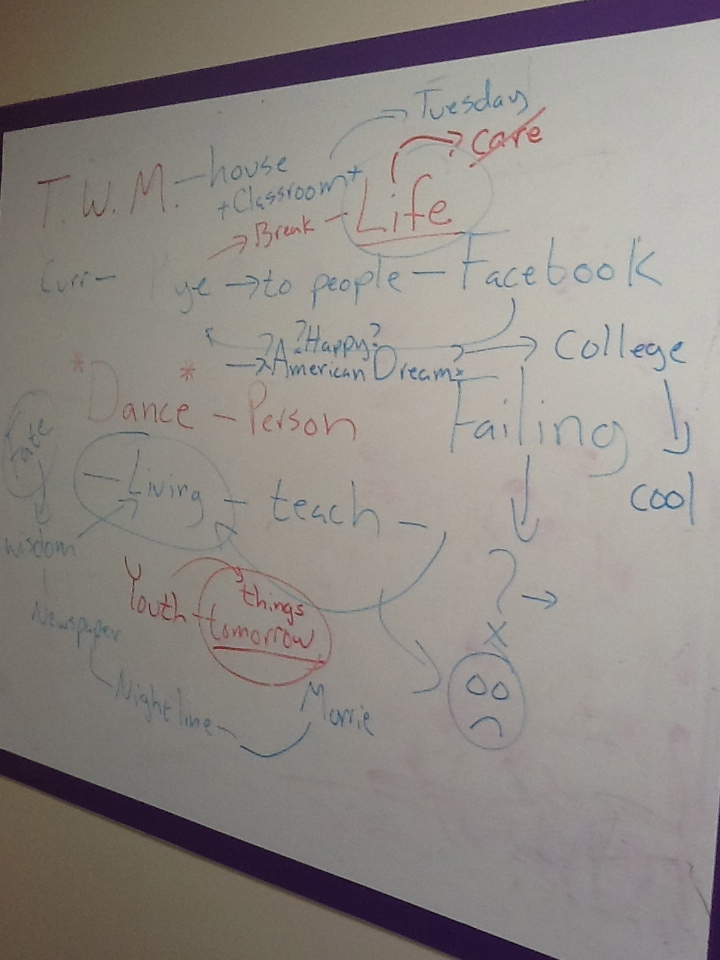
This is the semester that I teach American Literature for CCC Grand Island via distance learning.  For the first time we are reading Tuesdays With Morrie. Instead of creating my notes on a notepad or with 3 X 5 cards, I decided to use the highlight / note option in iBook.  Plus, I decided to project the book on the screen as I lectured and presented notes on the whiteboard.  Day one went well.

My Lecture Notes

As you can see above, my “notes” are crazy and always have been, even in my traditional classroom. The iPad 2 added some unique aspects to my delivery. A cool aspect was integrating YouTube videos into my lecture.  I love connecting pop culture references to my lessons.  As I formulated my notes, a couple of references came to mind and I cued them up on the YouTube app.  Then, placed a cue in the notes when to show them.  With a swipe of my fingers we went from book to video (slight buffering).

Another aspect I liked was that, in most cases, my notes did not hide the highlighted text, so the students could easily see both.  This didn’t happen 100 percent of the time, but over all both were visible.

The rough spot was me.  First, I am use to having my notes on paper or 3 X 5 card, and would have the same craziness on my own notes as you see on the whiteboard. That is the way I think (and usually talk, but I get to the point).  Also, my timing was not perfect in switching from me to the book.  Not a big issue, but I found myself writing on the board when the book was still on the screen.

Talking with a few of the students after class, they said they liked the approach.  They said that seeing the highlighted sections helped.  They also enjoyed the videos; it allowed them time to think and presented a different insight to an idea in the book.

I hope to collect some quotes from the students (an assignment they have) and use those in the lecture as discussion points.  Overall, I like the ease of using the book with the highlights and notes imbedded in the text.  Plus, being able to use one of my favorite tools, pop culture allusions, adds some fun to my lecture.

Share your story of how you are using the note and highlight option in iBook in the comment area.

A sneak peak at the book if you haven’t read it.

Leave a comment

Filed under Education, Technology

Mobile 2012 Reflections

As the weekend winds down and I get some time to reflect on the Mobile Learning Experience, a couple of things come to mind right away.

Point One: The energy from the conference was intense.  The conference was big enough to meet a new person at every breakout session, yet intimate enough to make real connections with people.  Even the schedule worked into this with the meals.  I was able to sit with my colleagues, yet have new people to meet at every meal.  The keynotes were also an integral part of the energy.  Each message was connected to the conference, but unique to each keynote.  I walked away with different ideas because of each speaker.

Point Two: The power of mobile devices. The first aspect is from Graham Brown-Martin’s keynote, which is we are still not tapping into the power of mobile technology.  We are using a technology designed to be mobile in an immobile environment. Now, what educators and schools are doing with them is awesome!  I’m pushing the idea farther, as I was thinking during Graham’s keynote and tweeted the idea that teachers use Mondays as a “Keynote” day, then, let the students go the rest of the week.

I understand that wouldn’t work all the time, but it brings up the second aspect of the mobile devices and technology: options.  There is a time for lectures (think about how powerful the keynotes and breakout sessions were), a time for worksheets, a time for tests even.  A buzzword right now is differentiation.  Simply put, options.  Mobile devices equip both students and teachers with that.  As an example, I will use simple story structure as a lesson.  In class we might read, listen, or even watch a YouTube video of the story.  I would have some vocab, which I could have a stack of flashcards for them to study, or even have them design their own.  Then, allow the students to show they understand story structure by writing a story, filming a story, or creating a cartoon.  All of which can be done on a mobile device.

Which moves me to the third point: the Teacher – Student relationship.  I started an interesting discussion about app development for teachers between breakout sessions, but I didn’t get the opportunity to finish.  Understand this discussion had the chance to be one of those incredibly deep pedagogy challenging discussions, but I never had the chance to bring it up again.  At the beginning, my inquiry was on the idea of equipping teachers to be able to build apps that would help students in their study of a lesson.  The opposite side was that the students should build them.  I don’t disagree with that, but one aspect I see of technology is the empowering of teachers to be what they went into this profession for, to teach.  Teachers can be the experts again of their field.  If fostered correctly, teachers should be the experts of the curriculum, not the textbook or a website.  The “options” available to connect to the content pushes teachers to raise their game.  And that, as a professional, is exciting.  Our jobs are changing.  Our challenge is to actually design a learning experience that gives students the tools and motivation to live by the highest expression of their talents.

Mobile 2012 was an incredible opportunity for me as a teacher.  I cannot wait to hopefully be a part of Mobile 2013.

Leave a comment

Filed under Education, Student Work, Technology

Keep the Fire Burning

The 2012 Mobile Learning Experience has been an incredible opportunity for me as an educator.  The sessions and face-to-face conversations have ignited ideas that I can’t wait to try.  I also had the privilege to present a session, which allowed me to examine the tools and ideas I use in my classes.  My goal for the presentation was to hopefully generate one idea for the people who attended.  I am excited to continue building relationships with the people, that up until now, I have only known through Twitter.  I am sure many of the educators are feeling on fire, full of ideas, and then….

Monday morning.

How do we keep the fire burning?  Like any fire, you need to keep it fueled and give it space to burn.  And the first step is to take one of the ideas and just try it.  Even if the first attempt fails, it still sparks our passion because we want to do well.  The first step is the hardest, but is needed if we want to keep the fire going.  So, when Monday morning comes be ready to fuel the fire and try a new idea.  Who knows what stories you will have for us next year!

Leave a comment

Filed under Education, Technology

Student Work

The following slide show is a collection of pictures from students revealing a look at the father – son theme in The Natural.

The following is a student presentation. (Click on presentation to advance)

Leave a comment

Filed under Education, Student Work

I don’t Matter

I have been moved to tears by two movies lately, but I will get to that in a moment.

I do not matter.  Nobody really reads my blogs, or notices when I do not tweet, or update my Facebook status. This is my fist year without any coaching responsibilities, and I miss it, but the games go on.  ESU 10 will not shut down if I am not there, or even if I move on.  I do not matter on a grand scale.  But I will get back to this in a moment.

I have been moved to tears by two movies, A Better Life and Louder than a Bomb.

One of the themes that connect the two movies is the importance of the everyday.  The importance of finding the meaning in life by our everyday struggles. Whether we write poetry or work hard for our family.  These two films express the why behind those struggles and relates the power we have to make each moment matter.

I do not matter, except to a few people, most importantly my family.  I have made difficult decisions that I felt would be the best for my family.  I strive to create a better life for my wife and children.

I matter to a few students.  For all my failures, I have simply tried to empower my students to find their own voice.  Have I succeed?  Not all the time, not with all the students.  But I have tried.  Every day.

For whatever reason life has been reinforcing the idea that every day matters.  For me, for you, for the people we interact with every day.

We matter for each other.

3 Comments

Filed under Family, Life

Another Student Essay

Brady’s essay takes a look at how an object/idea can be an antagonist for a story. He states that he doesn’t like to write, but I think you can read his talent.

The Street as the True Antagonist

            The nasty enemy, the bad guy, the evil adversary. No matter how it’s phased, almost every story has an antagonist. But who is this character in Ann Petry’s The Street? In this case it is not a question of who, but what. In the novel, the true antagonist that works against Lutie is the street itself.

First, let’s look at the definition of an antagonist. The Glossary of Literary Terms at UNCP.edu establishes, “an antagonist is a character in a story or poem who deceives, frustrates, or works against the main character, or protagonist, in some way.” The street fits this definition perfectly. In the beginning, the street deceives Lutie. Throughout the novel, it employs different methods to frustrate and discourage her. In the end, the street succeeds in breaking her will and defeats her. It is able to do this by using people like Mrs. Hedges, Junto, Jones, and Boots as its minions.

At first, the street appears to be an escape, a way out of the situation with her father and his girlfriend. She needs somewhere cheap and the street looks to be the answer. The street uses deception to lure Lutie in. When she first arrives on the street, she sees Mrs. Hedges in the window. She speaks with her in a pleasant welcoming voice. Mrs. Hedges’ pleasantness convinces Lutie to inquire about an apartment. Though some things about the place disturb her, she moves in anyway. She believes that it will only be temporary, assuring herself, “I’m young and strong, there isn’t anything I can’t do”(63). She does not realize she has been coaxed into a trap.

After she moved in, the street began to show its nasty side. It began to use any methods at its disposal to discourage Lutie from success. Lutie also begins to notice the people around her, people that the street has already claimed as victims. Lutie sees a girl whose brother has just been stabbed to death. The girl has a resigned look on her face, and Lutie thinks to herself, “She had lost the ability to protest against anything – even death” (197).

Another example is a girl she sees in the hospital. The girl had been severely stabbed, yet her face showed nothing but acceptance and disconnect from the situation. It was as though she had been expecting something terrible to happen. The street is trying to make her accept failure and defeat as a norm.

The street also uses men like Jones, Junto, and Boots to make her believe that she must give up her body and dignity to succeed. Even Mrs. Hedges, a woman, plays into this stereotype, offering Lutie a job essentially as a prostitute. Lutie realizes with disgust, “If you live on this damn street you’re supposed to want to earn a little extra money sleeping around nights” (86). The street gives her a false sense of hope when she is offered a job singing at the Casino. She then discovers that the real reason she is there is because Boots and Junto have sexual motives. At this point, the street has worn her down, but not conquered her. She is frustrated and angry, but she still holds on to her determination to be successful.

The street is finally able to break her when it targets Bub. Jones sets Bub up to get arrested. When Bub is taken Lutie begins to lose hope. Then, Boots attacks her and attempts to rape her. She is forced into a rage. After she murders Boots, her will is broken. She tells herself, “She was a murderer. And the smartest lawyer in the world couldn’t do anything for Bub, not now, not when his mother had killed a man” (432).

She then purchases the train ticket to Chicago and abandons Bub. While she sat on the train, all she could think about was, “It was that street. It was that god-damned street” (435). It was indeed the street that had been working against her all along. It gave her false hope only to take it away. Now that the street had broken her will, it had claimed another victim.


Leave a comment

Filed under Uncategorized